Showing posts with label Indie. Show all posts

Wednesday, July 15, 2015

looking at: Terraria


2D Cubes

Digging downward is the constant goal for most of the game.
Is Terreria just Minecraft on a 2d plain? Perhaps, at one point. That's certainly how it started, and how it was for the first patch or so. But then some magical things happened to it, and Terraria became more then a 2d Minecraft. It became it's own game, and in doing so became a better game that that which inspired it.

Terreria is, in essence, just Minecraft 2d. You manipulate the world around you, digging and mining for resources while building whatever you want in a completely destructible world. That much is the same. It's where Terreria differs from Minecraft that sets it apart and sets it above the blocky billionaire.

Dig It

The lowest regions of the map are covered in lava, and will test you'r jumping ability.
As stated, you do a lot of mining and digging in Terraria. There's a massive catalog of things to craft, and in order to do so you'll need resources. This starts out innocent enough, as you chop trees for wood, attack the weak slimes for flammable gel, and mine surface veins of copper and various metal types. You'll need to construct a home base to survive the night, lest you succumb to the hordes of undead and various demonic beasts, and here-in lies the first of Terraria's many gimmicks.

See, you don't need a home for just yourself, although that's important too. You'll also need to expand and create rooms to house the game's various NPC's most of whom offer useful services. The guide, who spawns next to you, can tell you how to craft any item. There's also various vendors for things like guns, general equipment, magic, and explosives, and a variety of other unlockable services to discover. Creating a base big enough to facilitate all of these NPCs is key to moving forward, and a great way to track progress, something Minecraft sorely lacks.

That's the key in Terraria, tangible progress. Not just digging further and further underground, since the end-game content isn't even found there, but actually moving towards goals. It's ok that a game lets you pick your own goals, in fact some of my favorite games like Mount and Blade or Euro Truck Sim 2 exist solely to let you create your own narrative. The important thing is that there is a created goal to work towards. In M&B it's becoming the ruler of the entire map, in Euro Truck it's becoming a shipping magnate, and in Terraria it's gearing up and fighting the next boss.

That's no easy feat either, since Terraria's enemies and especially bosses, are incredibly challenging. Most of the foes you'll face air just on the right side of annoying, and they each have quirks you'll need to figure out. There are some issues with combat, like how you can become locked in a tight space with an enemy on top of you and never able to hit them, but for the most part it works. Bosses are their own experience, and will often require actual preparation to face, be it crafting new and better gear or clearing an arena to fight in. The rewards are worth it, in the form of better gear or crafting materials, and with enough practice and skill you can begin to farm bosses like normal enemies.

By Sword or Shovel

Boss fights require proper preperation, and reward you with rare loot and materials.
In terms of actual gameplay, I guess Terraria is a platformer, since most of the game is spent jumping around while exploring underground. The control scheme is simple enough, and the character handles fine on the two dimensional plane. I've only played a demo for the console version of Terraria, so I can't speak too much about it, but in my opinion this is a game best played on PC. There are hot-keys for things like dropping torches and using grappling hooks, and the menus are huge and annoying to maneuver without a mouse.

Mouse control is especially important for the other half of gameplay, that is, crafting and creating. Rushing through menus is a breeze, and that's important because there's hundreds of items to craft. Outside of a few necessary pieces of furniture for crafting, all home decor is completely optional, but it's nice to create a space you can call your own and customize each NPC's room the way you want.

Crafting isn't just for home decorating, obviously, and there's hundreds of weapons, armor, and accessories to create as well. Weapons in Terraria can be imbued with special effects, so crafting an item multiple times might lead to a new and better version of it. How about a pickaxe that deals fire damage, or a sword that steals life? Add a healthy stream of rare loot from treasure chests and it quickly becomes an addicting cycle of looting, crafting, and exploring.


Old is New

The opressive darkness of the underground creates a palpable tension, and torches are a must.
Minecraft often gets discussed for it's graphics, or sort of lack thereof. Where that blocky billionaire chose to be Lego-esque, Terraria is instead more reminiscent of SNES titles like Super Metroid or Castlevania. In fact, it's sort of tempting to call Terraria a MetroidVania in it's own right since it features a similar feel when it comes to upgrades and progress. If it weren't for the myriad of systems running in tandem, you could probably pass Terraria off as one of the best unknown SNES titles and people would believe you.

The graphics work very well to create the proper mood for the gameplay. It hearkens back in the best way to older adventure titles that were light on story and heavy on gameplay. Terraria is a game that's more interested in letting you explore the world it generates, and the story is non-existent. The pixel work is excellent, and the world bleeds together naturally, rather then jarring separations between areas.

It's worth noting that the version I replayed for this review was the recent 1.3 patch, which has a bevy of visual enhancements over the original game, all of them for the better. Each biome has it's own hand drawn background setting the mood for the zone perfectly. Lighting is great, requiring you to have proper illumination to move foreward into the unknown.

On the audio side, Terraria is serviceable. I didn't care much for the music and found myself supplementing my own instead. It's not bad, mostly generic pixel chiptune music that fits with the SNES feel of the game, but it quickly became boring. Similarly the sound effects can become annoying after the thousandth time, and it's a good thing there are different sounds for digging each type of ground because that's most of what you'll be hearing. There's no voiced dialogue and character noises are just generic grunts. Monsters do have unique voice clips and these are perfectly creepy, if not a little generic.

Impulse Buy

The venerable grappling hook is likely the most useful item, underground or otherwise.
Terraria is a game that punches way above it's weight class and delivers perfectly. It's a tiny game, but it's so jam packed with content it's easy to forget that. It feels like everything just works in Terraria, be it the exploration or combat, or just sitting in your fortress, surrounded by treasure you earned.

In the end, Terraria is a game I picked up for a few bucks the day it came out because I was curious. That same day this $10 indie title beat out the recently released Skyrim as Steam's best seller, and since that day I've logged over a hundred hours, be it exploring on my own or with friends. That's 100 I've loved, and thanks to yet another massive free overhaul patch, there's likely another 100 hours left to experience.

Sunday, March 15, 2015

Looking at: Hotline Miami 2


Ring Ring

Brief moments of calm break up the non-stop action.

It once took SBnation writer and destroyer of EA Sports games Jon Bois 344 tries to pull off the impossible. Occasionally playing through Hotline Miami 2: Wrong Number felt similar to that, struggling to pull off the impossible, always just an inch away from victory. You don't throw footballs in Hotline Miami 2, however, unless they're directed at some poor bastard's head.

As a followup to the 2012 indie darling, HM2 certainly has some big shoes to fill. It fleshes out the story, changes up the gameplay, and adds some new touches, but is this a phone call worth answering?

Prerecorded Message

The blood and gore have been increased from the original to incredible proportions. 

Gameplay is unchanged, as it should be. HM2 controls from a top down perspective and your goal is to kill everyone that isn't you in a given level. You'll have access to a variety of weapons and ways to do this ranging from guns, to knives, bats, and chains. Sometimes. More on that in a bit.

Action is brutal and breakneck, with most levels only lasting a few seconds. The trick is that you die in one hit, be it rifle fire or a lead pipe, so completing a level requires a perfect run. You're also scored on your performance, creating a purposely uncomfortable mixture of rush tactics and the desire to stay put and plan out strategies. That's where dying comes into play.

Not unlike Dark Souls before it, death is used as a mechanic in HM2, albeit sans the story explanation. Restarting a chapter is instantaneous, and clearing a section can take dozens and dozens of attempts as you learn and plan your way around.

One New Voicemail

HM2 never shies away from controversy. 

The gimmick in HM2 is that, unlike the first game you play as a cast of characters, rather then one psychopath wearing different masks. Each character has different abilities that change how they play, although there are a number of milquetoast "normal" characters. There's Corey the Zebra that can roll dodge and use windows, Tony the Tiger that eschews weapons in favor of his fists, Mark the Bear wields a pair of SMGs that he can fire in two directions, and most interestingly are Alex and Ash two characters that control as one using guns and a chainsaw. There's also a writer that goes for non-lethal takedowns, a mysterious cop, a soldier and a repentant mobster. Each character handles slightly differently and figuring out which one to use is important.

Or it would be if HM2 was designed a little better, ie. more like the first game. Hotline Miami 2 has a bigger focus on it's story this time around, a welcome change from the first game, but what this actually means is that your freedom is limited more often then it should be. There are a handful of levels that let you run wild at your leisure, but most of the time you'll be told exactly which character to use, and trying to deviate will all but render the level impossible. That's only the first of my issues with this sequel.

Wrong Number

HM2 flips back and forth between fact and fiction, and you're never quiet sure which is which.

The level design of the first HM was damn near perfect, offering constant mixtures of long hallways, short openings, and huge wide-open areas that forced you to constantly react and rethink on the fly. What it usually did best was allow you to figure out how to proceed, letting you pick your path of destruction. HM2 doesn't do this so much, with most of the levels being scarily linear, and with hallways that are way to long so that you get shot from an enemy you couldn't see. When the levels do work they work gangbusters, but this doesn't happen nearly enough.

That sightline issue I mentioned is a real problem, and bleeds into another issue I have with HM2: it's reliance on guns and it's unwillingness to let you use them. Some character can't use guns whatsoever, and Tony the Tiger can't even pick up weapons to throw. That might be fine except that the levels are all bigger and more often then not strangely designed for guns. I didn't like using guns in the first game, since I found they cheapened the experience, but here it was either go in double barrels or use plan B over and over again. Plan B was to expose myself for a second, wait until the idiotic AI rushed me, then take them down in melee. Effective, but it really fucked up my level score.

You can still shift-look in HM2, that is holding down the Shift key to extend your range, but I often found myself over-using this and got annoyed when the level didn't let me extend further. The default field of view quickly became to small and constrained and I struggled to see and mark targets effectively from a distance.

The AI was always inept in Hotline Miami, but now they seem especially off-base. Enemies would either run straight at me in a murderous rage, or spin around in a circle for no reason. I've lost count of how many dogs I've seen spinning like tops. Worse is that the designers seem to think that more enemies means a higher difficulty setting, and you'll always find yourself completely overwhelmed. This does, of course, encourage more tactical gameplay as you separate enemies and take them down in manageable numbers, but you'll likely lament at the amount of times you've killed one guy with a crowbar only to instantly be taken down by his buddy beside him.

The biggest issue I had with HM2 was it's constant inconsistency. Enemy weapons are randomized, as well as their movement paths, which made proper planning very difficult. What happened the last four tries didn't happen on try #5, and only half happened on #6, meaning that I was never really able to plan my advance leading to more unnecessary deaths then I can count. This isn't a stealth game, I realize, but I do approach HM2 like a puzzle game, and that's difficult to do when it doesn't remain constant from attempt to attempt.

Click

The insidious phone calls from the first game are back, although less frequently.

It might sound like I didn't like HM2, and at some points while playing the game I think I didn't either. The truth is, though, I do like HM2, but only in short bursts. I found if I played only a level or two at a time I could sort of put up with the game's bullshit, and the feeling of accomplishment for actually pulling off a perfect run is unbeatable. You feel like a god for that briefest of moments and it's a dangerous rush because you'll want it again and again.

I haven't yet mentioned the soundtrack, which is probably the only part of the game improved on since the first one. That's saying something, since HM had one of the sickest, most enjoyable soundtracks ever put into a videogame. There's a lot of what made the first game great, with heart pounding tracks layered in with smooth calming beats. HM2 also starts moving towards the rock end of the spectrum, fitting as the game itself moves into the early 90's, and you hear more variety in the music then the first game.

Hotline Miami 2 isn't a bad game, and in many ways it's not even a bad sequel. Everything that made the first game great is here, but it's often buried under the desire to make HM2 something it isn't. There's to much filler pushed in beside the goodness of the core game, and it brings the experience as a whole down because of it. I enjoyed my time with HM2, but I don't know if I'd actually recommend it, at least not until a few patches and the promised level-designer feature release. Perhaps, for now, this is a message best left unanswered.


Saturday, February 7, 2015

Looking at: Rogue Legacy

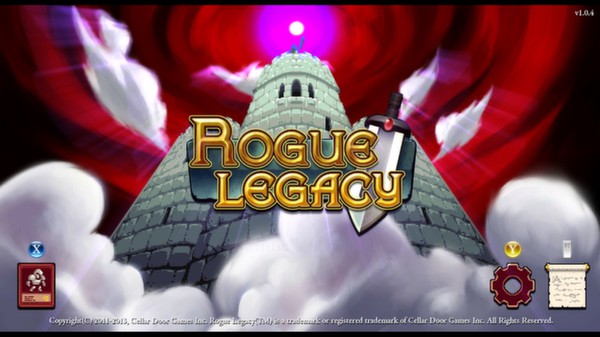
http://cdn.akamai.steamstatic.com/steam/apps/241600/ss_42804c992b120b548816f72ddbf4d4029df45063.600x338.jpg?t=1400700417

Lasting Legacy

The upgrade tree is exhaustive, and there's three of these.

Long before games had the ability to contain voice acting or coherent plots, they were only about the joy of exploration. Shigeru Miyamoto has stated that his original inspiration for The Legend of Zelda was the fun he had exploring caves as a child. Games were simple, they were stupid sure, but the were all about letting the player explore the world and piece together what was going on themselves.

This idea has sort of gone by the wayside in favor of deep involved stories and exposition out the ying-yang. I'm not saying this is a bad thing, and some of my favorite games in the past few years have been story-heavy. But there is a sort of yearning for a game all about exploration, a return to form and a joyous challenge. A game like Rogue Legacy.

Genre Mishmash

Bosses offer a heady challenge, and taking them down will take time and practice.

The title Rogue Legacy is incredibly apt, as this is a Rogue-like game with a legacy system, that's also paying homage to the legacy of games from the past, and also it's something of a rogue title amidst more mainstream games. Wait! Come Back! It's not as crappy or pretentious as it sounds!

Gameplay wise RL is technically a Metroid-Vania style game, although it's really closer in style to Legend of Zelda 2: Adventures of Link. You move through a 2d world comprised of a castle, dungeon, forest, and a haunted tower. The world is, being a rogue-like, randomly generated every time you re-enter it, although you can lock down a layout for a substantial penalty to gold collection. You'll fight your way through hordes of enemies, jump around, and solve the occasional puzzle. There's bosses to fight, challenges to overcome, and every once and a while a minigame to attempt. It's all fairly standard stuff.

Death to Live

You'll need to choose your character carefully before you attempt the castle.


Where Rogue Legacy sets itself apart is it's use of death. Almost, but not quite, taking a page from Dark Soul's book, death is education and often just what you need to overcome a challenge. After you die you get to choose a new adventurer and spend all of the gold collected on your last run, with the caveat that you'll loose the gold once you start a new run. You'll purchase new upgrades and equipment before attempting the castle again. Can't beat a boss with your mage? Get killed, buy a health and damage upgrade, and spawn in as the much more powerful barbarian.

The other gimmick that sets RL apart is how your characters are chosen. Rather then letting you customize your character, every time you respawn you're given a choice of three potential characters, each with different strengths, weaknesses, and traits. It's this last item that really changes how you play RL. Traits affect gameplay is a variety of different ways, from incredibly minor changes like the bald or gay traits, to completely changing gameplay like flipping the world upside because of vertigo or making you miss-cast spells because you have two left hands. You'll often need to make a hard choice, as traits will be mixed and matched at random, and deciding on what traits to take can make or break a run.

While you can't customize your character, you can customize your gameplay. To do so there's a staggeringly large upgrade tree that allows you to upgrade everything from health and armor, to how much damage your downward thrust attack deals, to even the possibility of cheating death. There's also equipment and runes to buy and attach to your character, each with they're own set of balances. There's a boggling amount of options to play around with and testing out new builds is an interesting experience.

Castle funnies

Traits can affect everything from how you play to how the game looks.


Rogue Legacy is the kind of indie game that makes me happy. There's no pretentious "higher meaning" to it, it doesn't have some hidden message about stupid shit. It's a game that's meant to be fun, whether played for a quick burst on the bus, or for hours on end. It's a love-letter to games long gone without just trying to be a long lost game.

Rogue Legacy is also the perfect example of just using old ideas really, really well. It's not a particularly original game, save for maybe the idea of randomized character traits. But what it lacks in originality it more then makes up for in plain enjoyment. Challenging where it needs to be, yet accessible in every aspect, Rogue Legacy is a legacy worth spreading.

Thursday, November 27, 2014

Looking at: This War of Mine

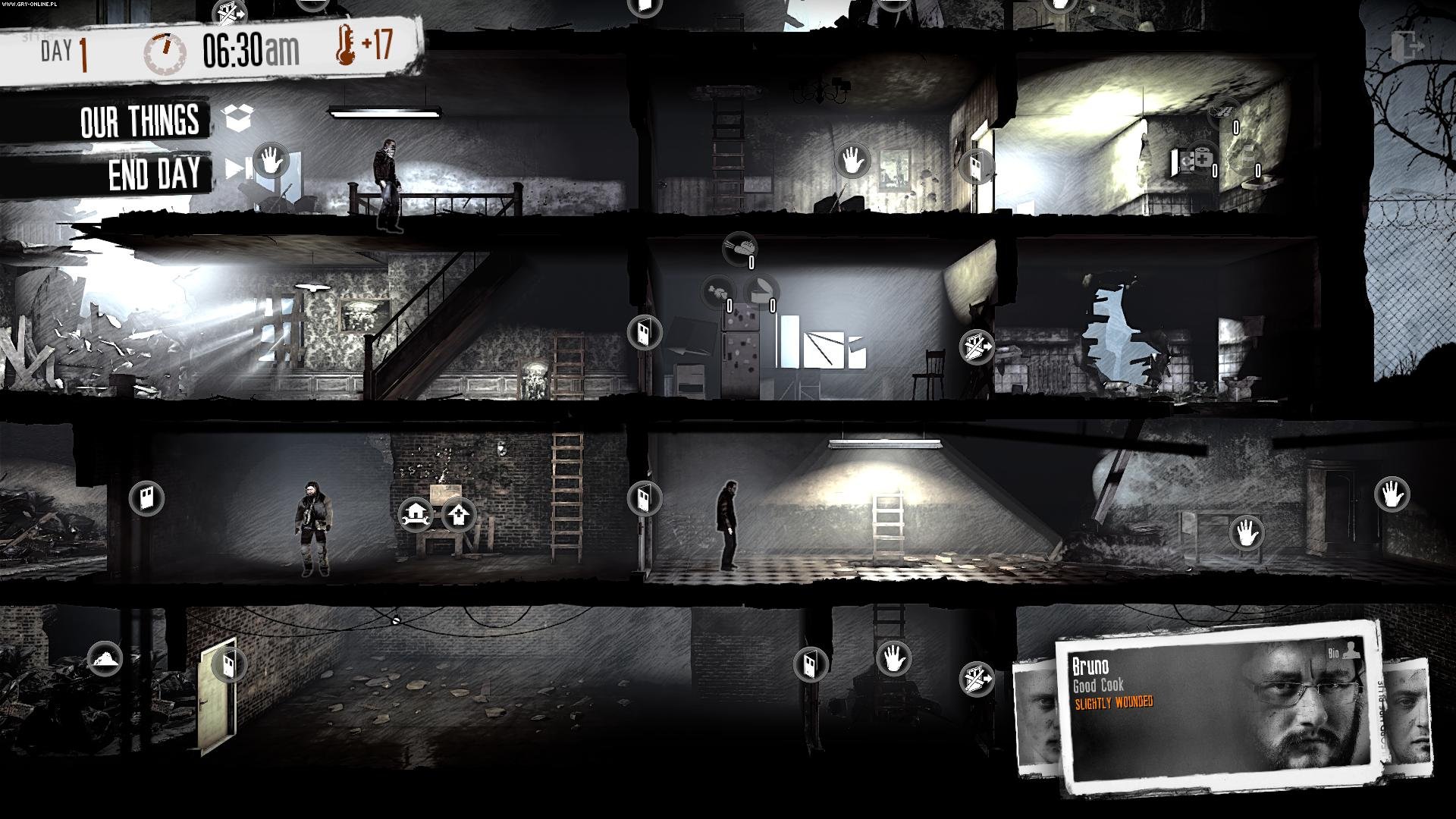
http://static.gamespot.com/uploads/original/78/787590/2484913-this_war_of_mine_screen_03.gif


Right Shift.


In a world post-Dead Island, I rarely trust video game trailers anymore. So many times have the games failed to deliver even the slightest bit of what the trailer promises that I've just become jaded to the whole thing. This War of Mine is a bit different through. No, the game doesn't involve a protracted gunfight in a ruined city street, but rather the cinematography of the trailer is what really sells TWoM, the entire game is a subtle shift off-screen.

I've always wondered what goes on just out of frame, be it in film or picture. With video games you rarely have to wonder, since most games give you free reign of the camera. But do they really? Think about the Call of Duty franchise for example. Sure, you have free reign over what you're looking at, but you don't decide what you see. Following their inclusion into the series in COD: MW2, civilians appear in almost every COD, but they're only there as moving distraction, part of the scenery. Other shooters are the same, with the game only showing what you and your team mates are up to. TWoM is a shift right, the camera has been knocked over, and now we're looking at what's usually off screen.

Black, White, Red.

http://static.gog.com/upload/images/2014/11/a213d1ed29489db6091405275cc541334c30c8d4.jpg

Nights are spent scavenging, and hoping no one else is. =

Everything about TWoM is a tonal shift, from it's subject matter down to it's graphical representation. The plot, as much as there is one, is you are in control of three survivors in an unnamed middle European country in the midst of a civil war. Your city is under siege and there's no escape. Indeed, there is no escape from anything in TWoM, and you'll send your small group through hell and back to see them to the other side. It's a game about survival, but it's more about what your willing to do to survive.

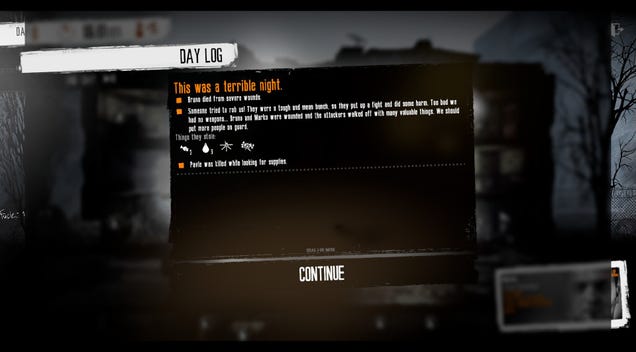
You'll have to worry about food, warmth, and everyone's health on a daily basis. The game starts a little easy, with at least a few days of relative heat, so you'll only worry about food. There's two phases, day and night. During the day you're confined to your shelter, and will spend time prepping food, making furniture, and crafting tools and weapons. During the night, one person will run out and scavenge while the others either stand guard or sleep. What happens back home is randomized, some nights it'll be quite, some nights you'll be attacked, and it all falls on your guards to sort the situation out.

Scavenging is one of the more interesting parts of the game, since it's the part where you'll have the most direct control over what's happening. You take command of the scavenger and direct them to loot locations. Sometimes you'll need to overcome obstacles, and sometimes you'll meet other survivors. These encounters are some of the more interesting parts of the game, as you can choose how to go about them in a variety of ways. The obvious answer is to run away, but this means you don't get any supplies, and food and medicine is almost always guarded. If you have goods to trade you can occasionally set up trades, offering useless items or items you have in excess in exchange for goods.

Both Sides.

http://i0.wp.com/apgnation.com/wp-content/uploads/2014/11/2014-11-11_00010.jpg?resize=820%2C461

Other people are often your biggest obstacle.

When stealth or peaceful discord fails there's always option three. This is where TWoM really goes for the emotional gutpunch. See, you can just kill anyone in your way, and occasionally violence is the only answer. But a lot of survivors you meet are just like you, trying to get through with meager belongings and barely a roof over their heads. Worse is that robbing and killing people will affect your characters. Doing deplorable actions can make people depressed, and eventually break them mentally. having one of your survivors killed can be ruinous to moral sending everyone into a deep depression.

It creates an interesting balance of "how deep am I willing to go to survive?" that we don't often see portrayed in games. TWoM is easily one of the darkest games I've played in some time, approaching The Walking Dead or Spec Ops: The Line levels of human reflection. There are no monsters in TWoM, only people trying to survive.

The Line Blurs.

http://mousenjoypad.com/wp-content/uploads/2014/11/356417917.jpg

Your home base, which can be upgraded over time.

To reinforce this is TWoM's striking visual style. The game looks like pencil sketches, with wavering lines and shades of black and grey. It's a great look and helps to sell the dark tone of the subject matter. At night the game looks great, with the darkness being an ever present entity, both friend and foe. Despite this look, things are easy to distinguish, and this is all helped by great UI tool tips that highlight items you can interact with.

What's perhaps most divisive about TWoM is how enjoyable it is. One the one hand it's an easy to play game, with plenty to keep busy with, and great moments of tension creating a rollercoaster of emotion. On the other hand, it's quite boring and repatative, with only a handful of items to make and no real direction or goal. The real question is whether a game with a message like this should be considered fun.

Spec Ops: The Line has often been praised for it's story and characters, but it's never received praise for being fun. Gone Home, for whatever reason, has received praise for it's presentation and story telling, but it's not been called fun. This creates the debate of should games with a message to them be fun? Does a game need to be enjoyable to play when it's trying to tell you something? It's like dressing a minister in a clown costume and asking him to do a sermon on the book of Job. Can he deliver his message? Probably, but we might not take him seriously while he's doing it.

For what it's worth, I think TWoM is enjoyable to play. It's really simple and easy to get into, and don't be surprised if there's an android/IOS port in the very near future. It's all mouse based, and the UI is just useful enough to make this not a hassle.

Gimme Shelter.

http://i.kinja-img.com/gawker-media/image/upload/s--FYqNUW5P--/c_fit,fl_progressive,q_80,w_636/bzu9sejvggbm83v4bjon.jpg

Coming back to a looted shelter can be a nail in the coffin for your group.

TWoM obviously comes from a very personal place. It's examination of war is so in depth that most games simply don't compare. It's inspired by true events from the Siege of Sarenjevo, and the stories from that have really shaped the game's experience. There are some issues with TWoM however. It's lack of tutorials means that the barrier to entry can be high, and this is made harsher by the random nature of the game. My first game I started with no food at all, and it took some time for me to figure out how to get some. The pacing is often painfully slow, and while you can skip straight to the night sections, this is rarely encouraged since you risk wasting a the entire day. The game is also brutally tough, although I hesitate to complain about this since it's supposed to be difficult.

This War of Mine is an interesting game, and for once it's an indie game with a message that isn't horrible or un-enjoyable. There's a legitimately good game here, and it's foundation is strong enough to make playing it fun. It's a game with a message that remembers that it's a game, and it's refreshing to see. It might not change anyone like Spec Ops: The Line did, but it's a great game with some great stories to tell.

Monday, November 24, 2014

Looking at: Banished

http://cdn.akamai.steamstatic.com/steam/apps/242920/header.jpg?t=1392746087

Wagon Train

http://media.gamer.nl/site/dump/20140225162457-ban4.jpg

You'll need to keep an eye on citizen's health and happiness.

Banished is a the first ever survival-horror-city-sim game ever, at least as far as I can tell. All of those genres already exist, and they all have standout titles, but Banished is the first game I can honestly say combines all those elements together at the same time. The question is, does it do it well, and is it worth playing?

The first answer is, yes it's an incredibly well designed game. Coming to us from one man developer Lucas Hodorowicz's Shining Rock Software, Banished is a testament to what can be accomplished when you really put effort into a project. The game was in development for three years before release earlier this year, and the effort shows greatly. The last few years have given us a lot of great one man games like Braid, Cave Story, and (despite Phil Fish being Phil Fish) Fez, and Banished is just another great example.

Died of Dysentery

http://www.shiningrocksoftware.com/wp-content/uploads/2013/03/A4-1024x576.jpg

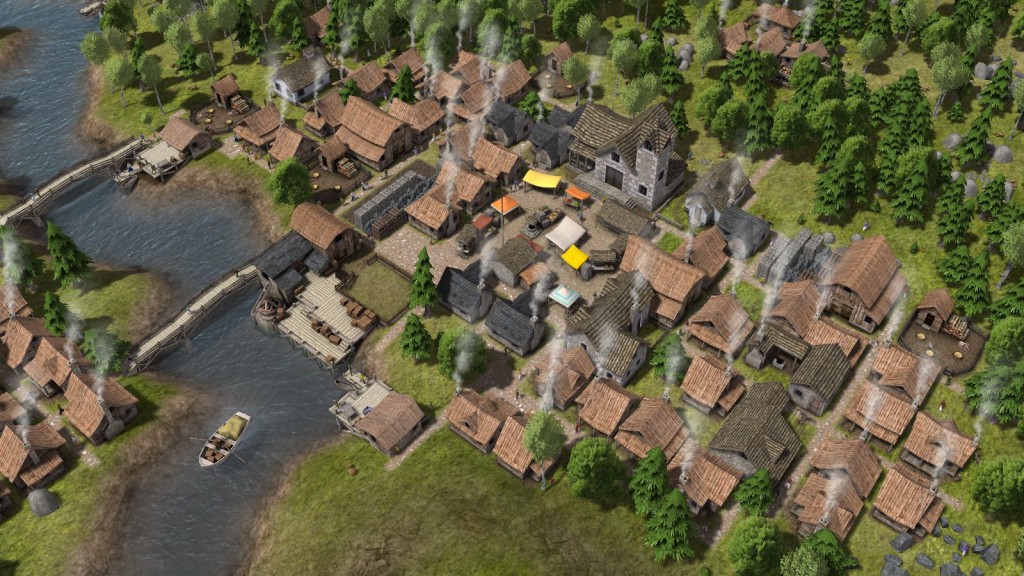
Creating a well functioning city is difficult, but rewarding.

The easiest way to describe Banished is a combination of Dwarf Fortress and Anno 1404. The problem with that explanation is that both of those are incredibly niche titles, especially the later title that was actually re-named in the west. At a glance, it's Sim City, circa 1400's. You construct a city, taking care to provide needs to it's citizens both basic and luxury, and try and see how far you can get before your hard work inevitably implodes on you. It's a complex game that embodies everything PCgaming stands for. 

Like so many managerial games, Banished is a mess of menus. Thankfully, this shows off one of its strengths: the UI. Designing a good UI can be difficult, especially for a game like Banished where so much of the game takes place in various menus, and it's great to see how much effort has gone into making everything accessible. The various buildings are all categorized according to their functions, with a separate menu button for all your various managerial tools. You can assign people to do jobs from one overview menu, or select specific buildings and add workers there. Constructing a town hall will grant access to various charts, and there are simple to use tools for checking happiness and health of your citizens. 

Hard Core Agriculture

http://www.incgamers.com/wp-content/uploads/2013/05/A2.jpg

Winter slows production to a crawl, and often brings with it death.

Where Banished differs from its contemporaries is its adherence to a hardcore nature. You will fail in Banished, quite often really. It's taken me somewhere close to ten tries to get a town to function successfully, and even then it's problematic. It all comes down to properly balancing everything. You'll need to provide food and warmth for everyone, but to do that you need to build houses and workshops, and to do that you'll need resources, and to get that you'll need properly maintained tools, and to do that you need people to work, and to get that you need to provide food and warmth for everyone. You'll constantly have several dozen plates spinning at a time here, and balancing them gets trickier the longer you survive. 

That's really the gimmick of Banished, just survive. The title of the game is derived from the proposed back story where your settlers are banished from their former home. You're abandoned in a forest with little resources and a steadily approaching winter, and all you need to do is survive. In a lot of ways its reminiscent of old frontier stories of the first settlers to America, sans the native slaughter, and its refusal to be anything but obtuse does a good job of reinforcing this motif. Doing repetitively simple things feels like an accomplishment, and surviving a winter or constructing a huge project gives you a feeling akin to Dark Souls. 

The Fire Consumes us All

http://i.imgur.com/IvxKe10.png

Fires can wipe out whole cities in seconds, and there's very little you can do to stop them.

Unfortunately Banished is problematic. There's a huge barrier to entry, despite the games modest price tag, and it's very hard to recommend it to people. I've always hated the way so-called "casual" gamers are portrayed by the gaming community, since I believe that games are for fun or interesting experiences, and nothing else; but I really can't recommend Banished to anyone who plays games casually. The managerial sim genre of games is already fairly niche, with only a few standout titles like Crusader Kings 2, Roller Coaster Tycoon, or the previously mentioned Anno series, so trying to talk about a game even more hard core then the norm becomes more difficult. Furthermore there's issues with the game itself, likely due to it's development. Like I said, it's a very well designed game, but graphically it's indie nature betrays it. There's a nice level of detail in things like trees changing colour with the seasons, or snow on the ground in winter. Like so many games before it, zooming in and trying to observe the little things is disappointing. There's very little detail put into the characters, and building are largely static. The different professions don't change what people look like, and there are only a small handful of animations for various actions. Landscapes can be difficult to read, and it can be hard to tell what's a buildable surface and what isn't.

Banished's biggest issue is it's balancing. It can be brutally difficult at times, and pleasently simple at others. Its a constant roller coaster, and you can't always control the speed. Citizens have a mind of their own, and construction projects will go unfinished for months without any explanation. Despite having a small army of people working to provide resources, you'll constantly receive messages telling you the stocks of food or firewood are low. You need to know exactly what to do from the first seconds of the game, and one small mistake, like queuing up a house rather then a fishery can cause everything to fall apart. Disasters like fire or disease can occur randomly, and there's very little in the way of proper prevention you can prepare. 

Banished is a good game, but only if you like games exactly like Banished. Considering how barren the world of managerial sims is, it is nice to get one that tries to add new ideas, and once you get on its wavelength there really is a great game here. Is it well made? Yes. Is it fun to play? Not always.