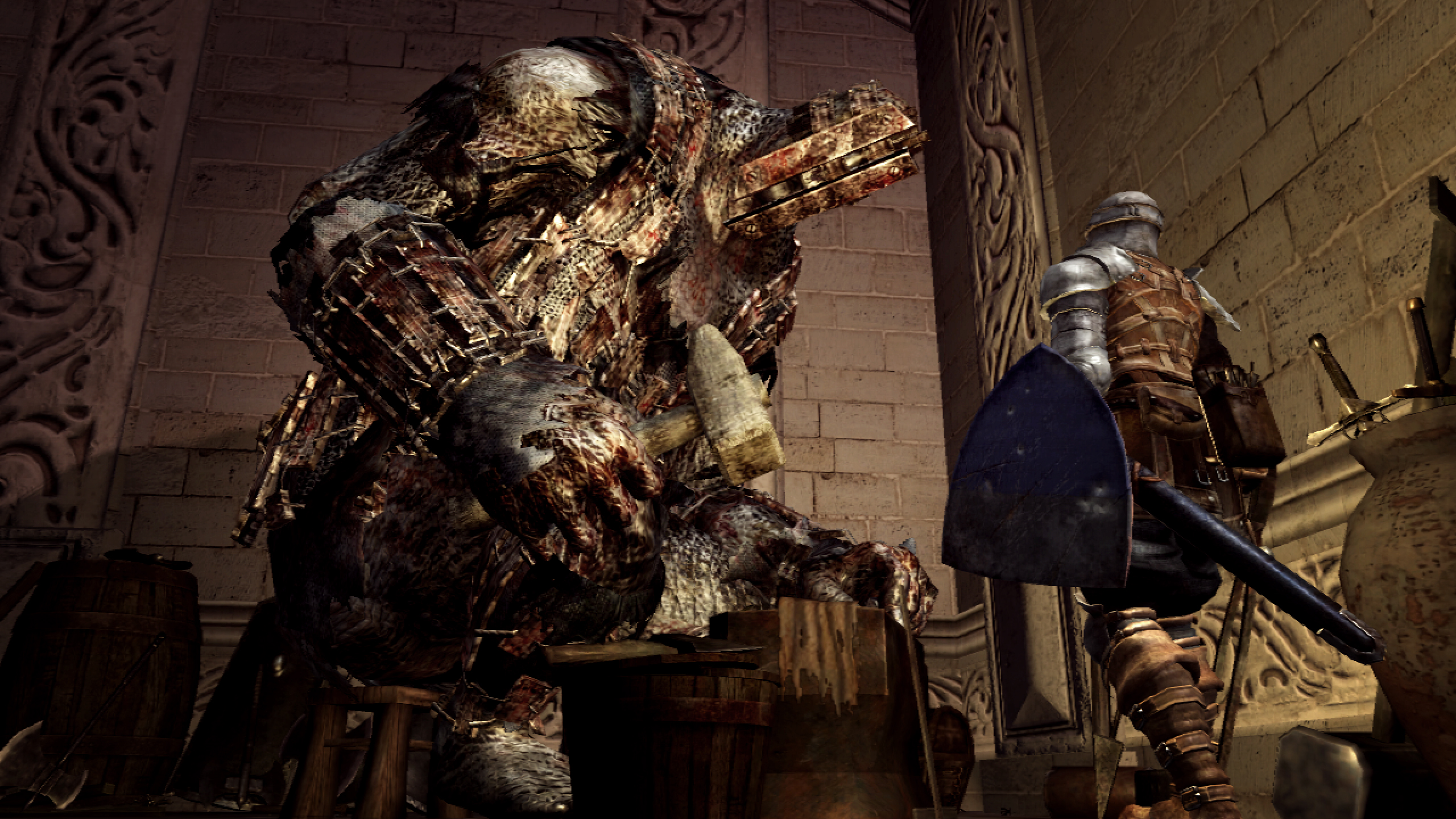
Showing posts with label RPG. Show all posts

Friday, July 31, 2015

Looking at: Lords of the Fallen


Imitation...

Conversation trees are a nice addition, but they don't do much to change the game.
Ok, let's get this out of the way right now. LotF is a blatant, BLATANT attempt to ape the tough-as-nails style of the Souls series From software have previously released. We all on the same page on that? Great.

It's ballsy for a game to attempt to be another game, and it's even ballsier to try and take on a series as well loved as the Souls games. Does LotF live up to it's Eastern cousin, or is this one death not worth respawning from?

Long Winded

Plenty of armor and weapons choices allow you to customize Harkyn however you want.
The setup for LotF is that you are Harkyn, a former prisoner that's been gang-pressed into service as part of an expedition to a remote abbey. The abbey is over-run with demonic creatures known as Rhogar, and it's up to you to stop their incursion and push them back to their world, pretty much single-handily. There's some minor twists that you'll see coming a mile away, and some choices that change the outcome, but it's all fairly straight forward and delivered in such a blunt manner that it's impossible not to follow.

This sort of sets the tone for LofF's attempt to mimick the Souls series, and it's repeated failures, often spectacularly. Where the Souls games were always content to drip-feed story through the use of item description and background details, LotF fires the plot at you double barreled and makes damn sure you know what's going on through repeated use of cut-scenes and dialogue trees, two things the Souls games have almost none of.

The issue with all of this is that the story isn't good, in fact it's pretty awful. I had to look up the main character's name since they don't say it in-game for a few hours, and I couldn't even tell you any of the other character's names. Compare that to Dark Souls' roster of memorable characters like Patches, Andre the Blacksmith, or the Knight Solaire and it just falls completely flat. Even with the addition of player choice, the plot never goes anywhere interesting, and what should serve as justification for your actions just gets in the way and slows the experience down.

Slow and Steady

Bosses are truly grotesque, and show some great creepy design.
Not that the gameplay itself keeps up a good pace. LotF is an incredibly slow and tedious game to play, even when using a light equipment set. Harkyn moves like a brick shithouse, and the weapon animations are so slow you'll need to add a few seconds to whatever mental math you're working out in combat. Not all weapons, mind you, just the ones that do any damage whatsoever to the spongey enemies that plague your path. Just walking around, even in light or medium armor, felt sluggish, and it's a damn good thing the levels in LotF are so small because trying to move Harkyn across a huge open field would be a worthy test of patience.

Enemies themselves don't really help at all. They're well designed, sure, with some really grotesque looking abominations bolstering the ranks, but there's an overall lack of variety to them, and even several hours in I was still facing off against literally the first enemy in the game. Worse, is that the enemy design and combat in general seem to aim more to annoy rather then challenge. Enemies don't always alert you of their attacks, and so, so many attacks either stun-lock you or break your guard instantly. There are several enemies that instant-kill you no matter what, as well as enemies that attack using damage-over-time attacks that wear down your health. For every fair, well paced fight, there's three of so instances where the game throws a bunch of foes at you simultaneously, and the non-linear but-not-really design of the game means you can spend a lot of time and resources battling enemies that you don't need to because they're guarding a locked door reserved for several hours later.

That's the whole underlying issue with LotF, is that the whole thing is so goddamn aggravating, but with no payoff. I rarely felt good after defeating a tough enemy, and at best I'd feel exhausted and angry, not satisfied in any way. Bosses weren't challenging, they were just annoying, with some of the worst hit detection I've seen in a long time. There's a mid game boss that could bash me from across the arena, but his actual weak spot was smaller then my character's head. This wasn't an exception either, as I found hit detection to be a regular issue as my attacks flew through enemies, and things I was sure I dodged slammed into me full force.

Proper Gothic

Killing a boss does... something to Harkyn.
If there was one thing I liked about LotF, it's the art style. I'm a sucker for gothic looks, and LotF reminded me of Warhammer in the best way possible. Armor and weapon sets especially made me giddy, and I genuinely enjoyed the look and feel of the various equip-able items. It seemed like no matter what I put on Harkyn he always looked like an unstoppable badass, and that made me feel, briefly, like a badass myself.

Overall the game looks pretty decent. There's great smoke and lighting effects that help to sell to mood, and enemies look grotesque enough to make you want to kill them. The monastery itself looks proper old-school gothic, and the realm of the Roghar looks alien and frightening. Character models don't fare nearly as well, as they all look terrible, and lip synch was hilariously off, although I'm willing to be that's at least partially a translation issue from German to English.

Audio, however, doesn't help LotF at all. Weapons don't sound as weighty as they feel, especially because they're going so fucking slow it feels like they're made of bedrock. Clangs, smashes, and all other weapon sounds are just tinny and un-fulfilling. That's if they don't cut out randomly, like most of the other sound effects. It's particularly jarring when you walk through a door way and the super loud sound effect that was in the background a second ago just cuts out for no reason because you're now in a different area.

Voice work too, isn't great. There's nothing overly wrong with any of it, but it's all so bland and generic that I'm actually struggling to remember any one character that stood out. Harkyn is any gruff bald white dude voiced by Not-Nolan North/Troy Baker/Steve Blum/Roger Craig Smith. Other then that, there's a tough-as-nails action girl, some old dude, some other old dude that's obviously evil, and a host of righteous crusaders that make you want to hate them instantly.

Dialogue, like sound effects, cuts out randomly, and it reminded me in the worst way of The Witcher 2's endlessly repeating dialogue, only instead of running through an entire conversation a million times, this would be an instantaneous restart because my character moved an inch to the left of the dialogue's trigger area. Overall, LotF has some of the weakest sound design I've seen in a long time, and I eventually found myself just listening to music while playing the game, rather then suffering through the game itself.

...is the best form of flattery

The design looks like Warhammer in the best way.
I think, to a certain degree, I'm biased against LotF, because of my love and respect for the Dark Souls series. If the intentions of the developers were to just simply ape From's masterpiece, then it's a noble attempt. They even tried to change things up, like how the longer you go without using a checkpoint the higher your XP multiplier gets, creating a risk/reward system as you move forward. And, compared to most other modern RPGs, LotF at least tries to challenge you, rather then giving you the world on a silver platter, it makes you fight for your fun.

But it's a fun not worth fighting for, and it's a world not worth saving. The worst part of LotF is that playing it just made me want to go back to playing Dark Souls again. When your game is so mediocre that I'd rather just play a completely different game, then it's a game I'm going to forget about and never play again. At the end of the day, Lords of the Fallen just isn't as good, isn't as polished, and isn't nearly as enjoyable as Dark Souls is. Maybe they can solve that with the recently announced sequel, but for now this is one imitation that's not worthy of the original.

Friday, June 12, 2015

Looking at: The Witcher 3


Witcher Hour


The Wild Hunt spreads fear and icy death whereever it goes, and it's up to you to stop them.

The Witcher 3 is a game so good it's created a backlog for me. There were other games that I really meant to play, but that I put off because of TW3. It's a damn good thing I have a full time job, or I probably wouldn't have left my apartment for the 70 or so hours it took me to finish TW3.

I really liked this game. 

Alright, let's break this down so I can explain why I liked this game so much. The Witcher 3, as to be expected, is the third in the Witcher series by CD Project Red, a Polish studio that also runs GOG.com. CDPR don't make games that often, in fact the Witcher series and the upcoming Cyberpunk 2077 are the only things they've ever made. My theory for that is because CDPR knows that good games take time, indeed Witcher 3 had a development cycle of at least two years that we know of, and damn does it show. TW3 is, hands down, one of the finest RPG experiences I've ever had, and joins the pantheon of great Western RPGs like Morrowind, Dragon Age: Origins, or Baldur's Gate. 

Call a Professional


As a witcher you'll take contracts from anyone, including emperors.

TW3 once again places you in the boots of Geralt of Rivia, a Witcher, that is, a mutated super-human that hunts monsters for a living. Although there is plenty of monsters to hunt, your primary goal this time around is to find a female Witcher named Ciri, Geralt's adopted daughter and the biological daughter of the Emperor of Nilfgaard, one of the two major factions in the game. Geralt is given a number of leads to follow to find Ciri, and... that's it actually. The story from there is pretty much left up to the player, as the main plot never really moves from the "find Ciri, save Ciri " angle.

Rather then focus on the main plot, TW3 is much more content to focus on it's side stories. While there are simple fetch or kill quests, many of the sidequests can spin out into their own miniture epics, taking you across the land and unraveling into stories worth telling, often with completely different outcomes based on your choices. There are some truly gripping tales to be found throughout the world, and it makes the game feel more like an episodic TV series at times.

Geralt of Rivia: monster slayer and lady killer.


Apart from the sidequests, there are also the monster hunts. One of the biggest complaints about The Witcher 2 was that the game forgot that Geralt is a monster slayer. Worry not, because there are monsters to slay in bulk here. At any point you can walk into a village, take a contract, haggle the price, and carry out the hunt just like a real Witcher would. Like the sidequests, these too often end up being more then they should be, behaving like investigations from the Batman games. You'll need to gather information, track down the monsters using Geralt's new Witcher sense, and plan your strategy.

The world is burning, but is it worth saving?

W3's approach to story telling, both in the main game and sidequests, is all about investigation. You'll need to learn about what you're doing, rather then charge in swinging your swords, and it's a refreshing change from most games these days, to content to just hand you everything. It can make the game feel overly long, and the plots have a tendency to drag on, with Geralt himself getting upset at the amount of backtracking, but it's all worth it and the delivery saves the game from tedium.

There's no set morality meter in W3, which is good because it would almost constantly be stuck right in the middle. The world is an awful, horrible place to live in, much closer, I imagine, to what living in an actual medieval country side might be like. Racism, sexism, xenophobia, rape, and murder are all common-place and it makes the concept of saving the world that much more challenging. There's bad blood in the land of Temeria, and it's spilling in bucketfuls.

Whereas Skyrim squandered it's set up of a war, Witcher 3 thrives in it, using it to craft the world and shape how events unfold. Everything and everyone is tainted with the constant threat of death, be it at the hands of monstrous beasts or one of the two armies burning the country side, or the Wild Hunt, a band of marauding interdimensional elves that kill indiscriminately. Not all of the monsters in the world of Witcher 3 have fangs and fur, and you'd do well to remember that throughout.  


Bombs, Blades, and Flaming Handshakes


Adventures will often lead you to the weird and unknown.

Combat is largely unchanged from TW2, but refined down to what it should be. Geralt now has the ability to dodge and roll, each with their own uses. Once again, you'll have access to a steel sword for normal opponents, and a silver sword for extra-normal enemies. There's a selection of bombs to craft, potions to brew, and magical signs to upgrade.  

The big change is just how fights feel. Geralt feels like he should, fast and fluid and a flurry of action. This isn't Dark Souls, and you'll need to learn how to fight properly against each different enemy. While dodging and heavy attacks might cut it for one enemy, you'll need to use signs and bombs on a different one. You'll need to master every part of the Wither's arsenal if you want to stay alive and claim your rewards. 

You'll be able to level Geralt however you see fit, mixing and matching skills and mutations.


TW2 tried to have an openness to it's levels, but at the end of the day they were only extra-large restrictions on relatively small maps. Once again TW3 is going whole-hog and features two of the largest, most detailed game maps I've ever experienced. There are two continents to explore in TW3, the European countryside of Velen, nicknamed No-Man's land due to the ongoing war, and the cold and bitter Viking-inspired islands of Skellige. Both are massive, easily rivaling any other open-world on the market, and the open nature of them is a natural fit for Geralt's adventure, letting you act like a real Witcher as you go town to town accepting contracts and saving lives. Even better is the fact that it's not an empty world. There are things going on around you, like packs of animals or patrols or bandit raiding parties, and it not only helps sell the world as immersive, but kept me engaged for that much longer. In a lot of ways it reminded me of Red Dead Redemption, and I say that as a point of very high praise. 

There's always a Dame


Ciri is more then capable of handling herself, and playing as her is a blast.

What good is a great world if there aren't any interesting people populating it? Thankfully TW3 features some of the most well written characters I've seen since Fallout: New Vegas, and it seems like every person has a complete backstory and a good reason for doing what they're doing. The whole game takes place in the midst of a massive war, and the effect this has had is clearly evident. People are scared, some are angry, and there's as much in-fighting between various factions as there is between the two armies. You'll need to contend with the armies of the Northern Kingdoms, the southern Empire of Nilfgaard, and the various independent groups like the Free City of Novigrad or the hyper religious Witch Hunters. As is often the case, helping one group can, and likely will, anger another one and you'll need to choose your allegiances carefully. Sometimes the smallest choice can have huge, unseen consequences and might mean the difference between a hard fight and a good conversation.

Most interestingly is how I found W3 handles it's female characters. Geralt may be an unkillable badass, but he does seem to have a weakness for women. I don't think it's unfair to say that most of his decisions are based on this weakness, whether it be for one of the various sorceresses that seem to use him for their own gains, or his adopted daughter Ciri. To often women characters are scrutinized in games these days, but I can honestly say the women of Witcher 3 are among my more favorite. Each seems to have their own motivations and alternate agendas that work to flush them out into three dimensional characters.

Your choices, no matter how minor, can greatly affect the outcome of quests.


By far the most interesting is Ciri, whom you actually get to play as in short sections throughout the game. When I heard there were going to be linear sections of playing as Ciri I was skeptical, seeing as it broke the flow of the game. But after the first few sections of her gameplay I began to look foreward to it, and the final few times I played as her were an absolute blast.

Ciri plays just the right amount of different from Geralt, having not been completely turned into a Witcher. She also has the power to warp time and space, allowing her to blink around, changing the dynamic of combat. By the end of the game she's a living super-weapon, and just awesome to see in action. CDPR hasn't said anything, but I would definitely play an entire game as her.

Flashing Steel

If you've paid attention to the development of Witcher 3 you've no-doubt heard about the graphical downgrade that happened during production. Here's the video from Digital Foundry that shows a comparison between the E3 2013 demo and the finished version in 2015:


It's pretty plain to see that the game doesn't look like what it should have, and it's been all but confirmed that it's because of the console version. The good news is, the game still looks great, and the better news is I played it on PC. 

People have commented how they don't like the cartoon-like look of TW3, and I don't know if I completely agree with that. On the one hand, it does sort of downplay the grimy feel of the game world, with the political meandering and rampant human hatred. On the other hand, despite the downgrade in graphical fidelity, I still really liked how the game looked. I'm a sucker for a splash of color in my games, and I really dug the almost idyllic feel of the country side. In a lot of ways it reminded me of games like Legend of Zelda, and it gave me just the right amount of nostalgia. 

That's not to say the game looks bad, quite the opposite. Temeria is a lush and gorgeous place to look at, and Skellige is the perfect mixture of Irish country side and Nordic viking heritage. I loved just walking around and taking in the sites, and every location felt unique and well realized. All of this is helped by some great lighting work that made the day feel bright and vibrant and darkness feel oppressive and mysterious. Dungeons in TW3 require the use of torches to navigate, and it's so nice to actually see a game that does this, rather then keep the brightness cranked to max. If there is one issue I had with the graphics it's that there's often a split second of pop-in when scenes transition, and it can be jarring when hair or armor loads before the 

If you have the rig to run it, Witcher 3 looks fantastic.


I've explained before that I don't inherently have anything against console gaming. Some of my favorite games of all time are on consoles and I understand the appeal of a game you can just sit down and play without figuring out configurations. That said, many recent releases reinforce why I prefer my PC over consoles, and Witcher 3 is another good example. I was able to consistently hit between 50-60 FPS on High settings, and I've seen people with much worse computers then mine get great results on lower settings too. The game scales great too, looking fantastic even on the lowest settings. Nevermind the ability to mod it. For my playthough I had installed a simple ENB graphics mod and it made the game look great. 

The audio design was equally great, which is nice considering audio was one of my bigger issues with TW2. Voice acting is once again fantastic, especially veteran Doug Cockle returning once again as Geralt. While Geralt's range of emotion is somewhat stunted, Cockle does a great job of making the character feel real, and delivers each line perfectly. The rest of the cast ranges from great to serviceable, and while it's unfortunate that the game too often uses the "generic UK regional dialect" trope, there's enough variety to make you forget about it. 

Geralt's heightened Witcher's sense highlight important quest markers, as well as loot. 


The real winner though is the ambient sound design. The music is great and all, fitting with the world when it's quiet and flaring up when shit is going down. Even better is everything else, and I loved just sitting in the forest and listening to the trees and grass sway in the wind. That's a weird thing to say, sure, but it's so well done and fits into the world that it really was an awesome experience. 

The best display of both the visual and audio aspects of TW3 is the monsters, particularity the bosses you often face at the end of Contract missions. Each fight with these beasts is memorable, not only for the investigation that leads up to the battle, but because the monsters themselves leave a lasting impression. Monsters look creepy, terrifying, and real, and the sound threatening and boisterous. These are beasts, wild and crazed, that won't hesitate to kill you at a moment's notice. Even the non-hostile creatures exhibit memorable design, and it made them really stand out. 

Fireside Epic

Sailing, horse back riding, and the card game Gwent are all welcome additions to the formula.

TW3 isn't a perfect game, but it's few issues are minor and the good outweighs the bad by a mile. There are issues we see popping up in open-world games all the time, most of which are just funny rather then annoying. Characters popping in for no reason, the AI not knowing how to react properly, character models not moving, and general oddities with the physics engine. It's rare that I ran into a glitch or bug that impeded progress, and I don't recall any issues that actually made me stop playing. 

If there is one major complaint I have it's the controls. I played the entire game with a gamepad, and while I've heard KB&M works ok, I prefer games of this type on a controller. The issue is how Geralt seems to react to your input. He's over 100 years old, sure, but he's supposed to be superhuman. I lost count of how many times he bumped into a wall, or just a random piece of the environment, and he felt sluggish and slow when just moving around. Combat largely avoids this issue, thankfully, but just walking around can be a bit off-putting. Even worse was the horse controls, which often just didn't work properly. I began to dread using my horse and was very thankful for the ability to fast travel. 

This is easily Geralt's finest hour.

The Witcher 3 is a rare breed of game, one that strings you along for an extended tour and manages to keep you engaged for the entire experience. It's an adventure that made me feel like an adventurer, solving problems, saving people, and being a sword swinging badass. It's an RPG that let me play a role, making me be a character while letting me define that character. Finally, it's a game that I enjoyed, even despite the occasional challenge and the extreme length. It's a game worth playing, that's for sure, and hands down one of the best and most engaging RPGs in a very long time. 

Wednesday, April 22, 2015

Looking at: Dark Souls 2


The Old Guard

The odds will often be stacked against you, you'll need patience to get through.

The first Dark Souls has been called a masterpiece, one of the most important games ever released, and one of the best RPG games ever made. Accolades have been heaped on it for nearly every aspect, from the brutal difficulty, open ended nature, interconnected world, and sparsely told plot threads. Indeed, between the PS3 version and the PC re-release (which was recently FINALLY moved off of the terrible Games for Windows Live) I've put dozens up dozens of hours into fighting and dying in Lordran. Clearly a sequel was inevitable, and early 2014, Dark Souls 2 was released upon us. Is this a dungeon worth delving, or was this death in vain?

The Darker Soul

occasionally you'll have a chance to indulge your inner firebug to solve puzzles.

Like it's predecessors, Dark Souls 2 is a game about dying, fighting, and dying some more. You've come to the land of Dranglaic to seek treasure and fortune and have instead become cursed to stay there forever, trapped between life and death. To heal yourself you'll need to kill the four guardians and rekindle the primal fires before slaying the land's monarch and claiming the throne. In order to do this you'll suffer through a series of challenges killing all sorts of monsters and bosses along the way in your campaign of destruction.

DS2, like Dark Souls and Demon's Souls before it, keeps it's plot purposely obfuscated, and likes to deal out small amounts of plot or lore through background osmosis, rather then hand it to you straight up. It's easy to miss the entire plot of DS2 and you'll often need multiple play throughs to understand some of the finer points of the lore. It's not that the game is poorly written, quite the opposite as there's a wealth of backstory to be found if you go looking for it. Rather DS2 is content in letting you piece together the world yourself, giving you the ability to do this and letting you figure it out. It can be disorienting at times, as you try and figure out what your goal is, but it's oddly refreshing in the face of modern games that just give you everything without leaving anything to the imagination.


Killing in the Name

Fighting with others can make any challenge just that much easier to handle.

This idea of letting you figure things out extends out to the gameplay. DS2 is a tough game, but it's a malleable game as well. Theoretically the entire game can be beaten with the starting equipement, as long as you get good enough to work within that parameter. That's one of my favorite things about the Dark Souls games, is that despite their intense difficulty, you really can play whatever way you want. For instance, one of my characters was named Punchy Joe. He never wears shirts and only fights using a pair brass knuckles. Using this hilariously underpowered character I've cleared about a quarter of the game with minimal issues, all because I adapted to how to play differently.

That's the trick of DS2, is that you'll need to adapt to win. Every fight is memorable, from your first zombie swordsman at the start, to the elephant man I just killed 20 hours in. All of these are constantly fresh in my mind because they have to be if I want to succeed. I learned quickly that the elephant man's pike has a long range, so I learned to stay even further away, just like I learned that the swordman slashes twice then stabs. Learning from your mistakes is the only way forward in DS2, and lord knows you'll make a lot of mistakes.

There's another reason the fights in DS2 are memorable, and that's because like it's predecessor they often lean towards quality and less to quantity. A level might only have a few enemies in it, and some of the areas are so small you can see the end of them from the beginning. The trick is that you'll suffer for your finish, and while there may only be five enemies in your path, it'll take you forever to chip away at them. Fights like this are often the norm and it's rare to see you facing a crowd, save for one particular boss fight. You'll need to conduct fights like an opera, making sure to only fight what you can handle at any given time and leaving room for a quick pull from your healing flask or breaking open a slow-acting life stone.

Accidental Death 

There are some truly gorgeous vista, but they often hold untold horrors. 

DS2 is a bigger and more ambitious game then the first one, and while this means that certain aspects have been improved upon, there are also numerous parts of the game that just don't work as well as the first one did. There are more then a few issues that didn't come up as much in the first game and, while none of them are necessarily game breakers, they do dampen an otherwise fantastic experience.

The first and most notable issue is the enemy AI. Dark Soul's AI has always been problematic, ever since the first entry Demon's Souls. The enemies only know to charge you and use their set of attacks, and don't bother with self preservation. While that means you can occasionally draw enemies into traps meant to kill you, I noticed that their AI was particularly inconsistent in DS2, often teetering between devious and dumb, flanking me one minute and walking into my obvious attack the next. Even more inconsistent was how the enemies fought me, lunging straight past me with one attack only to stun-lock me with the next three strikes. The simplest foe became a mini-boss fight when he managed to get me into a corner with attacks I couldn't block.

That brings me to DS2's biggest issue over the first one: your ability to avoid damage. In Dark Souls avoiding damage was all about dodging or blocking. You either had to be quick with a roll or carry a good shield. Either way it was possible to make it through much of the game while avoiding damage, making the few times you did get winged all the more strenuous because of how much they hurt. In DS2 something feels... off with the whole ordeal and it's largely due to some tweaks to the hitbox detection. More then a few times I've noticed the game subtly adjusting enemy attack patterns just so to make sure their hit lands, and the dodge-roll seems to have far fewer invincibility-frames then the previous game. You'll get hurt a lot in DS2, and sometimes it doesn't feel like a fair fight because of it.

Japanese Gothic

Each new area is introduced as you step into it, inviting you to explore it's secrets. 

Levels in Dark Souls had this interwoven feel to it, like the whole world was slowly unfolding before your eyes as you explored. Even with the most bizarre areas there was a logical progression to it all and there were plenty of secret passages and shortcuts to uncover. The world wasn't all that large on reflection, but what it lacked in size it made up for in spades with it's detail.

DS2's world is bigger sure, and there's a lot more to do, but all of this comes at the cost of logic and reason. There's an abundance of pointless areas that serve nothing more then to transition you from one dungeon to another, and the flow of the game often doesn't make much sense. Why does a ruined tower lead me to an underground shipyard? Why does a mining town lead me to a volcano fortress? It's confusing and seems much more piecemeal then the first game, like the levels were designed separate then made to fit regardless. The individual levels themselves are great, offering challenges and puzzles galore and are often a joy to explore, but getting between them often feels boring and it's a good thing fast travel is unlocked from the start.

Graphically DS2 is impressive, albeit not as good as it's own E3 trailer some time ago. The lighting does a good job of selling the somber and dark mood, while obfuscating traps or enemies. The texture work is decent, although falls apart upon closer inspection, and everything has a purposely ugly and ruined look to it. The various pieces of equipment all look fantastic and unique from each other, and there's a myriad of ways to make your character stand out, from the crazed jester to the noble knight and anything in between.

The audio work is similarly well done, with a great soundtrack of dark and moody music, just quiet enough to fit any scene while just loud enough to be heard over the clang of weapons. Weapons all have a distinct sound to them and everything from tearing through flesh and armor to smashing down doors sounds weighty and bombastic. Enemies often have their own unique soundbites letting you know their around the next corner, but rarely giving them away.

There's only a small handful of friendly NPC's to talk to, but the voice work is decent enough. They manage to sell their lines, often with an air of uncertainty, either about you or their current predicament. More entertaining are the souls completely lost to the madness who really just have fun with their characters. There's no one as charming as Solair or Patches, but the characters of DS2 are memorable enough. It's especially handy that the majority of them move to the central town during the story, meaning they're easy to track down and talk to again.

Mass Grave

You're not really the hero, more of a janitor come to clean up the mess. 

Multiplayer returns in DS2, largely unchanged from the first game. You'll be able to summon other players to your world, or be summoned to other worlds, through the use of in-game items, allowing you to team up and take down bosses. The changes this time are in how the humanity system works. In DS2 you can turn human at any time, no longer reliant on bonfires to do so, but the trade is that every death while not human lowers your overall health, down to a possible half bar. This makes staying human that much more important as you'll often need as much HP as possible, even just for the purposes of exploring.

The other big change in terms of multiplayer is the idea of Souls Memory. Rather then lock multiplayer summoning to a certain level range, it's now based on your soul memory, that is, the total accumulation of souls (in-game universal currency) you've gained with your character. That means a level 80 character can play with a level 20 character, so long as they're both in the same Soul Memory Bracket. It's a bit confusing at first, but it simultaneously makes it easier and harder to play with people, based on how much of the game they've played as well.

Once again, DS2's multiplayer is an all-or-nothing game, meaning that if you want to play with other people you'll also have to be willing to allow other players to invade your game. These encounters are often both the best and worst part of the game as I lost count of how many times I was backstabbed because of a bad connection between me and the invader. There is now an option to play offline hidden within the game, but it removes much of the best parts, meaning you'll have to take the good with the bad.

Sins of the First Scholar

The Pursuer Knight, a formidable foe that will chase you throughout the game.

The original DS2 came out in early 2014, and was a moderate success. There were three DLC packs released, each containing a new dungeon with new challenges and items. Seeing as it's 2015 and publishers are money sucking scum, DS2 has received the HD update/game of the year treatment in the form of Sins of the First Scholar. This version collects DS2 and all of it's DLC while changing the graphics over to DirectX 11 and changing up enemy placement for a new challenge.

Right off the bat the best thing about SotFS is the 60fps lock. I've never been one to get into arguments about frame rates, but it's undeniable how much better DS2 plays at 60fps. It's a fast and fluid experience that really enhances the experience. There is some concern about weapon durability falling faster due to a glitch, but From software have already promised to fix that in an upcoming patch.

As for the new enemy placement, while it does balance out certain areas, From seem to have made the same mistake as Hotline Miami 2 thinking that more enemies equals a better challenge. It's unfortunate to see a game like this take such a terrible misstep and while it never ruins the game, it does make certain areas feel like a slog rather then proper challenge. Worse, with some of the new challenge it's difficult to recommend SotFS to a new player, despite the upgrades and multiplayer stability because the level of difficulty in some areas goes above and beyond to be annoying.  It's not a bad upgrade and I'm glad I got it, but it doesn't really do the Dark Souls name proper justice.

Dead and Buried


From shaded forest to rain slicked fortresses, DS2 is a big game.

It's unfortunate that Dark Souls has earned a reputation as one of the most difficult games ever made for a few reasons: First, it means that any half-baked indie game promising a challenge refers to itself as "Dark Souls-like". Secondly, it's just not true. Sure, there is a challenge to the Dark Souls games, but only if you fail to adapt to the game and begin to play with it as it would you. Dark Souls isn't just a game to be beaten, it's a game that dares you to embarrass it, make it feel sorry for ever trying to pick a fight with you. That's when it's at it's best and you truly begin to enjoy it.

I've never liked the idea that a sequel cannot be better then the original game, and saying a sequel isn't good because it's not the original annoys me. Unfortunately, that's simply not the case with DS2, as it's just not as good of a game as the original was. Maybe if it had the original director, or maybe if AI scripting was just a little bit better, or even if the levels were a little more concise this would be a better game. The fact is DS2 just has a few to many issues with it, and that's what keeps it down. Still it's still one of the best RPG's in recent memory, and definitely worth playing for anyone looking for a great challenge. At the very least, it's more Dark Souls, and that's exactly what I wanted.

Wednesday, March 25, 2015

Looking at: The Witcher 2


Kingslayer

As Geralt, you'll often face insurmountable odds. 

I hate the word "epic". Like most things it gets it's hands on, the internet has all but ruined this word, turning into a shambling, stupid, meme-spitting buzzword. I hate "epic"

But there's no other word to properly describe The Witcher 2: Assassins of Kings.

Witcher 2 is a huge, sweeping, mature epic fantasy that demands that you take it seriously as it strings you along. Is this a journey worth taking or just idle talk by the firelight?

From Poland with Love

The Witcher 2 can be beautiful when it wants to be.

The entire franchise of The Witcher comes to use courtesy of Polish writer Andrzej Sapkowski. The series centers around Geralt of Rivia, the White Wolf, and a Witcher. Witchers are mutated monster hunters that roam the land killing for money, and Geralt is considered the best among them. The books provide an entire back story, but the games are they're own self-contained tale, and you don't really need any fore-knowledge on the character or world to get what's going on. All you need to know is that shit is almost constantly in a state of fucked up, and Geralt really doesn't care at all.

The first game opened with Geralt running through the forest, waking up with amnesia, and slowly but surely piecing together everything that's happened to him. Throughout the first game he killed monsters, killed some great evil known as the Grand Master, and saved King Foltest of Temeria from assassination. There is more to it then that, but that's all you'll need to know about The Witcher in order to player Witcher 2.

The Witcher's Path

The upgrade, simplified thanks to the amazing Combat rebalance mod.

Witcher 2 opens with Geralt in prison. He's been accused of killing Foltest and is set to hang. Throughout the tutorial it's slowly revealed that another Witcher killed Foltest and that Geralt is just taking the blame. In exchange for his freedom, Geralt promises to track down the real kingslayer and bring him to justice. This serves as the central plot point throughout the game, as you track down the killer and deal with the fallout of Foltest's death.

The plot plays out like a medieval noir story, with secrets being revealed and motivations changing as more and more details come to life. It's a great story too, taking time to develop like a constant slow burn, and giving you time to digest what's going on. There's plenty of back story to wade through, with character descriptions, a full bestiary, and plenty of lore hidden throughout. The Witcher 2's world is easily one of the most well realized and complete worlds I've ever seen.

There are also side missions throughout every level, ranging from simple Witcher's work -that is killing monsters for money- to more involved quests like locating a lost laboratory, saving researchers from a haunted mansion, and more. The more involved sidequests will create entire stories independent of the main plot, with the majority of these being worth the time, if only for the great story.

Like I mentioned, choice means everything in Witcher 2. You'll often have to make decisions, whether minor or not, and live with the consequences. Practically this usually means things like avoiding a fight, or changing your opponents, but certain choices can vary the game's progression wildly, with the entire second act hinging on a few moments. These choices feel natural, and the game's reaction reciprocates this well so the entire process seems dynamic, rather then the "choose a color" scheme some other games choose to go with.

Whirling Dervish

Monsters are often as terrifying as they are massive.

Gameplay in Witcher 2 can best be described as "tactical swordplay". Geralt, despite his abundance of badassdom, can't really take a hit that well, even with late game armor. Instead his style of fighting relies on being faster then his opponents, be they man or beast, and making sure he doesn't get hit. In this regard I often found the most useful tool in the Witcher's arsenal his ability to dodge around like a madman, rolling or pirouetting out of harm's way in a second. More importantly, dodge was one of the few animations that would trigger correctly when I try to use them.

That brings me to the heart of the issue with Witcher 2's combat, is that it's all heavily animation based. That's fine, since all games are, but there's no real physics to the animations, and they play out regardless of what's going on. It's hard to explain, but play a comparable game like Dark Souls or even Skyrim and you'll understand. There's an odd lack of weight to your hits, like they're not really connected to anything, and this makes combat feel floaty and awkward.
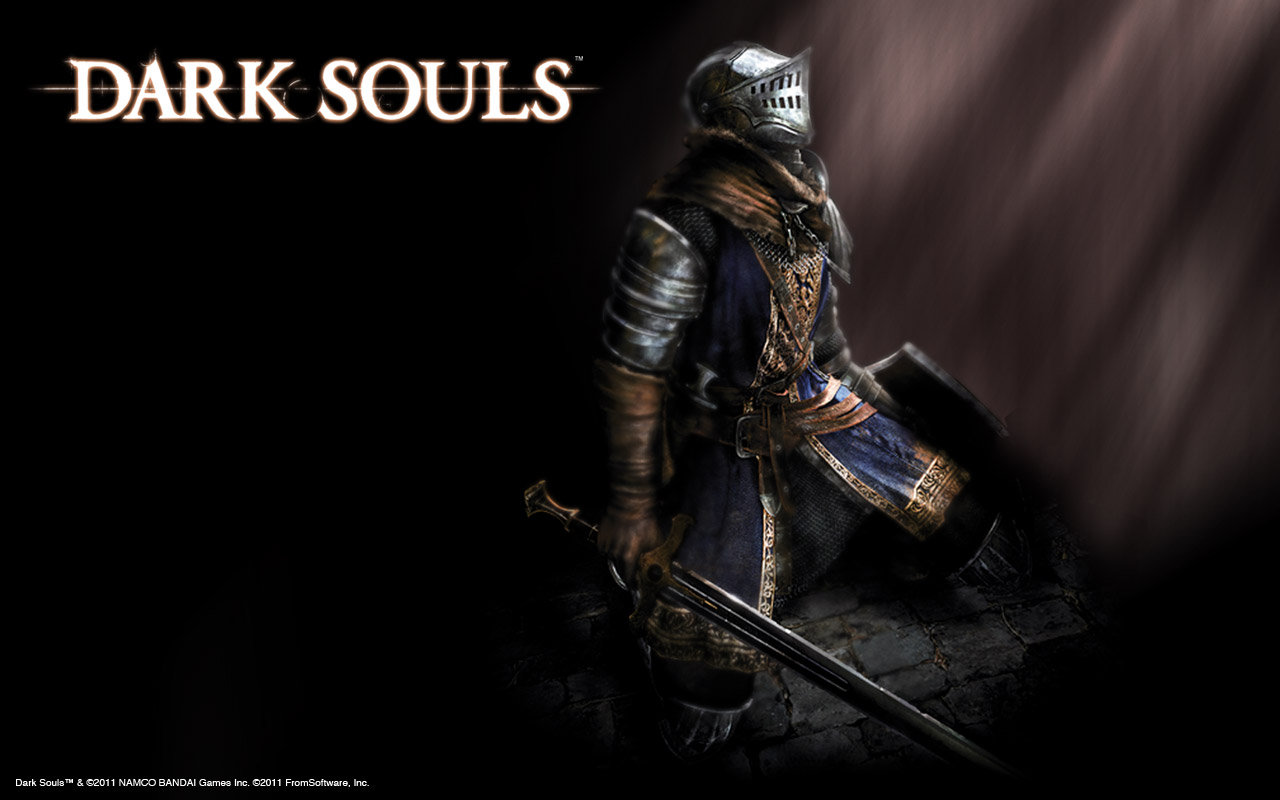
This is an issue for two reasons: One, when combat does work, and you kill your enemies in a flurry of blows and feel like a master swordsman, it feels great. The second issue is that combat makes up the large majority of the game between just normal monster hunting and encounters with human foes.

Combat is a mixture between using one of Geralt's swords (silver for monsters, steel for humans, despite what the novels may say), using one of the limited, but insanely useful, magical signs, and making liberal use of alchemy. This last one is particularly of interest as it reinforces Witcher 2's theme of preparation. Geralt isn't the Dragon Born, and he can't heal in the middle of a fight by eating a sandwich. Instead, you'll need to brew and quaff potions when you have a spare second, meaning that trips outside of town are limited to about as long as your potions last. It's an interesting idea in theory, and certainly makes the game more challenging, but quickly becomes annoying and tedious, not to mention aggravating when the game constantly forces you into situations where you're not given time to prepare.

Troll maiden

A moment of quiet before a battle.

There's an almost constant sense of awkwardness to Witcher 2, like it's a game that wasn't meant to be as good as it it. Dialogue interactions are strangely stitched together, and rarely flow well. Scenes don't as much bleed into one another like they should, but feel patched together, like they were constructed independently of one another and assembled after the fact. There are so many strange and unintentionally hilarious animations I lost count halfway through the second act. I've seen games that punch above their weight class and impress me by doing things I didn't expect them to do, but Witcher 2 seems like the exact opposite, making mistakes that a game of its caliber shouldn't be making.

The one area where Witcher 2 is consistently great is it's graphics. While the character models have aged a bit in the years since it's release, there's no denying that it's a great looking game. The lighting work especially sells the scenes, but overall the world looks and feels great, even when the things inhabiting it don't. 

On that note, a special notice goes out to monsters. Despite the promise of monster hunting, there are only a handful of monsters to hunt throughout the game, but they all look great. Each monster looks terrifying, and really fits the dark, ugly tone of the game. Everything from the undead zombie nekkers, to the towering Kyran octopus creature looks great and fighting them is all the better for it.

On the audio side Witcher 2 once again fails to deliver. Voice acting on the main characters is great, particularly Doug Cockle as the voice of Geralt and Jaimi Barbakoff as Triss Merigold, the lead female. Voice acting on the other characters though ranges from mediocre to terrible, and the sound mixing doesn't really help. VO actors either seem to close or to far away from the mic at times, and conversations seem to happen regardless of your proximity to them in the world. I was across town from a pair of dwarves talking and yet I still heard every word of their conversation. Worse is that each location only has a small finite amount of ambient conversations that play over and over infinitely. I can completely recite one conversation from the second act because it's the only thing I ever heard whenever I was in town. Using the incredibly useful Cat potion, which grants the ability to see in the dark and sense living creatures, was always a hard choice because for ten straight minutes it would play a beating hear sound that drove me nuts.

Monster Slayer

As a Whitcher you'll often be called to deal with magical creatures like the undead.

I don't know what to make of Witcher 2. I didn't know what to make of it when it was released in 2011, I didn't know what to make of it after the enhanced upgrade release in 2012, and I still don't know what to make of it weeks before Witcher 3's release in 2015.  Witcher 2 is a game that's great, even amazing, despite how terrible it is. This isn't a case of The Room where it's a bad property that's accidentally great because how bad it is, rather it's a case of a property that is so great despite it's many shortcomings.

In the end, there's nothing else quite like Witcher 2. It's a game of political intrigue, endless conversations, and brutal violence. It's a world of grey, where black and white morality simply don't exist. It's a unique experience to be sure, but I don't know if it's for everyone. Trying to recommend Witcher 2 is difficult because looking at it's individual pieces it's not that great of a game. Only when looked at as a whole does the game work, and from a distance it's a masterpiece. If your looking for an RPG that will challenge you, both in terms of gameplay and morally, then The Witcher 2 is for you, otherwise this might be a tale left unheard.

image sources:
http://www.technobuffalo.com/wp-content/uploads/2014/06/The-Witcher-2.jpg


Tuesday, December 2, 2014

Looking at: Dark Souls

http://img1.wikia.nocookie.net/__cb20131111214011/darksouls/images/e/ed/Chosen_undead_artwork.jpg

The Dark Soul

http://thumbnails.cbsig.net/CBS_Production_GameSpot/CBS_Production_GameSpot/2011/10/03/GameSpot/Gameplay_Videos/1/33/169_dark_souls_gameplay_boss_fight_ps3_100311_bell_gargoyles_2800.jpeg

The Bell Gargoyles, one of the many bosses you face. 

It's probably to early to say with full clarity, but Dark Souls is likely one of the best and most important RPG's of the seventh generation. There's no real way to tell until enough time has passed, but even looking back at it two years later it's importance is not lost on me.

The most important thing to know about Dark Souls is that it's difficult. Note that I didn't say it's hard. Hard is Battle Toad's infamous Speederbike level, where the game tasks you with doing something while providing you no way to adequately prepare for it. Dark Souls is difficult. It will beat you down, and do horrible things to you, but almost all of it's challenges can be overcome with some planning and strategy.

Prepare to Die

http://static4.gamespot.com/uploads/screen_kubrick/mig/0/9/6/0/2110960-169_dark_souls_gameplay_x360_093011_skeletons.jpg

Magic is an alternative to swords and axes, but comes with it's own limitations

Make no mistake, you will die in Dark Souls. You will die often, and it will always be painful. Maybe you fell off a ledge, or maybe you were pounded into mush. Perhaps you were decapitated, or just impaled with arrows. Death will come for you, and most of the time there's nothing you can do. But where most video games challenge you to stay alive for fear of death, Dark Souls uses death as an in-game mechanic. Death is education, allowing you to learn from your mistakes to better overcome them in the future. Sure, almost every game with a checkpoint has some form of this, but with Dark Souls it's almost encouraged. It's a weird sort of Trial and Error system, one that doesn't reward death, but rather uses death to teach. It's a bit hard to explain.

In short, you can, and will, overcome any challenge the first time your presented with it. Most of the challenges come in the form of cleverly placed enemies, and it often boils down to learning how to combat them within the terrain. But every once in a while, usually once or twice in a level, you will be caught off guard and sent to a quick death. This is where it becomes imperative that you learn from experience. Unless you do something stupid, like jump off a cliff or walk into an obvious trap, every death teaches you something, be it where an enemy is hiding, where a trap is pointing, or a foe's attack pattern, and learning from this will allow you to overcome.

Land of Ghosts

http://lazytechguys.com/wp-content/uploads/2012/03/dark-souls-9.jpeg

Bonfires act as save points, and allow you to level your stats.

Of course, there's always the multiplayer. Dark Souls' multiplayer is both intuitive, and terrible, although that's not completely the game's fault. The concept of it is that every player's game is separate, but players can enter other games either by being summoned as a friendly spirit, or invading in an attempt to kill the host. For further interaction players can also leave messages around the world, be it helpful hints or lies designed to trip people up. It's an interesting mix of PVP and PVE and when it works it works great. That's sort of the issue though.

I played Dark Souls on both the PS3 and the PC re-release and on both versions there were connectivity issues. It's worth noting that the PC version was worse, since it used the well documented terrible Games for Windows Live system. As of now Dark Souls PC is being migrated over to Steamworks, so I can't speak to it's stability, but the outlook is positive, especially given how much better Dark Souls 2 works through Steam.

Worse is the other players. Dark Souls' multiplayer is an all or nothing gamble, you either use it or you don't. There's no way to opt out of the PVP aspect, and with the prevalence of hackers, it can become incredibly dangerous to remain online. It's worse when attempting to PVE in a PVP popular area, as you can unwittingly become a member of a fight club you never wanted to join. The world of Dark Souls is harsh and punishing, but it's players are likely worse.

Boss Rush

http://www.gamebanshee.com/images/sobipro/entries/1764/gallery_33_1764_img.jpg

One of the game's smiths that will upgrade your weapons and sell you items.

There's not so much of an actual plot in Dark Souls. In fact, for the first part of the game you'll have very little knowledge of why your doing what your doing. All you know is that everything wants you dead, and there are bosses to kill. Rather then spend time building a plot, Dark Souls chooses instead to build a world, with every item having it's own lore, and every boss having their own back story. Eventually you do learn what your true purpose is, but it's still confusing and serves as just a reason to send you against various bosses.

The bosses might be the best reason to play Dark Souls. Sure the every day of Dark Souls offers challenges galore, but the bosses are the real tests. Boss fights in modern games have sort of fallen by the way side, but Dark Souls trots them out front and center. All of the bosses are memorable, either for the way you fight them or just their design. What's truly great about Dark Soul's bosses is that almost all of them can be easy. Each of the bosses has it's own weakness to exploit, be it an instant kill mechanic, or a trick to their environment. Theoretically you can beat each of the bosses without ever taking damage, as long as you figure out how.

That's sort of the unofficial theme of Dark Souls. Figure it out. It's not said as a threat or an angry declaration, but rather as a piece of legitimate advice. You need to figure it out. Dark Souls refuses to give you more then what you need, and wants you to learn how to break it. There's an inch here and there, an item that tips the game ever so slightly in you favor, but it's rare and you will need to figure it out. There are a dozen of plots and stories to find, you just need to figure them out. It's a game that rewards exploration, both of the world itself, and of the history and lore of everything.

Alone and Scared

http://canadianonlinegamers.com/wp-content/uploads/2013/11/Dark-Souls-2-Screen-2.jpg

Player invaders appear as red specters, and hunt you down.

It's difficult to explain why Dark Souls is so good, and it's even more difficult to actually recommend it. Even trying to classify it within the RPG world is something of a challenge. I hesitate to call it an action RPG, since it rewards patience and punishes rushing. It feels like an old-school RPG, but only because it refuses to hand-hold at all. Dark Souls is Dark Souls, it defies proper analysis and demands to be played.

I mentioned that I believe Dark Souls to be one of the more important games of last gen, and I still do. It's something of a stone pillar in modern gaming, a game that refuses to budge from it's spot. It doesn't hand-hold or coddle the player at all, but challenges them to learn the game. It rewards patience and planning, rather then tossing the player in head first and letting them win. If Dark Souls was a person they'd be the parent willing to let their kids fail, just so they learn properly.

It is, by no means, a perfect game. It's multiplayer is clunky and fails often. Despite the co-op, there's no easy way to play with friends. There's a total lack of control, with hacking rampant especially on PC. The graphics are passable, but they've aged poorly in the few short years, and come off as greasy. There are a number of "cheap" deaths that are unavoidable. Dark Souls also refuses to let a game mechanic just be a game mechanic, so everything is forced into the lore. On the console versions the frame rate is atrocious, especially in wide open areas like the swamps of Blighttown.

Dark Souls is a great game, provided you have the patience to work through it. I don't recommend this game for most people, even fans of RPGs. This isn't Skyrim, or even Dragon Age. It's not a pick up and play type of game. Dark Souls is Dark Souls, and there's nothing else quite like it.