Showing posts with label Sci Fi. Show all posts

Wednesday, August 5, 2015

Looking at: Alien Isolation


In Space...

Amanda Ripely, spitting image of her mother
Everyone remembers Aliens, the 1986 James Cameron sci-fi classic that pretty much shaped the modern sci-fi world. It's a great film, another example of James Cameron's amazing film-making abilites, and it's easily one of my all time favorite 80's movies, right up there with Cameron's Terminator 2.

What a lot of people don't remember, or don't remember as well, is the predecessor to Aliens, Ridley Scott's Alien (1979). Alien is a decidedly different film from Cameron's choosing to focus on a small cast, few action scenes, and a great horror vibe. It's this smaller, more intimate feel of Scott's movie that we find the setting for Alien: Isolation, one of the best sci-fi horror titles since System Shock 2.

The Apple Doesn't Fall Far

Emergency stations are your save points, and their beeping is an odd comfort.
A:I sees you playing as Amanda Ripley, a last name that should be instantly familiar to any fan of the franchise. Indeed, Amanda is the daughter of Sigourney Weaver's character from the films, and was about 10 during the events of Alien. Now, a decade later, the flight recorder from the Nostromo has been found in a backwater station on the far reaches of space, and Ripley, along with some Weyland Yutani executives, decide to go pick it up.

As you might expect, things don't go nearly as planned. Ripley and co. arrive at Sevastopol station to find it nearly deserted and completely in ruins. The surviving humans have split into warring groups and factions, scrounging around and fighting with each other. The station's AI has gone insane, turning the synthetic robots onboard into murderous killing machines. And there's the Xeno herself, come aboard with the Nostromo recording box and killing without mercy wherever she goes. Sevastopol, in other words, fucking sucks.

Under the Covers

Sevastopol is falling apart, and fire suppression almost never works.
Gameplay wise A:I is largely about stealth over everything else. Combat is hugely risky, the few times you actually can engage in it, and you'll spend most of your time crawling around avoiding a fight. Human enemies are easy enough to engage, and while the game emphasizes avoidance, you can lure single foes away and bean them over the head with your maintenance tool. That only works a fraction of the time, however, and only on humans, who aren't really your main concern. Synthetics, on the other hand, can't be attacked in a stealthy manner, can withstand a fury of blows, and will hunt you relentlessly, even through a hail of gunfire. They're creepy, monotone, grey as the moon, and really hard to kill, making them the perfect enemy for a game all about sneaking around.

Of course the biggest threat is the Xeno, huge, hulking, and black as night. Everything about how the Xeno is handled in this game is amazing, and it makes the whole experience that much more terrifying and authentic to the film it's based on. The Xeno doesn't even show up for the first 90 minutes, rather you follow her path of destruction and death so that when you do get a look at her you're instantly aware of how dangerous she is.

Dangerous indeed, since the Xeno's attack is an instant game over. This might seem aggravating, and it is at times, but it reinforces the idea that you need to avoid her at all costs. A:I is a game that demands patience, and you'll find yourself waiting out the Xeno in cupboards or under tables while moving through her patrol pattern. If you get board easily, this is really not the game for you.

Fear and Loathing

Alien: Isolation's lighting does a great job of creating atmosphere.
There is combat, but as I said, it's mostly a last resort option. There are a few weapons, a trusty revolver or a flamethrower, but open firefights draw the Xeno, and no amount of ammo can take her down. The rare time the game does force you into a fight, it's usually in a way that you can easily control the situation, and only with a handful of combatants.

This is for the better, since A:I might be one of the worst shooters I've played in a while, strictly speaking as a shooter. Weapons handle like shit, and they're just not fun to use at all. Again, this all feeds back into the stealth and avoidance, but when you do have to pull iron and fire it's a horrendous experience that almost made me long for Aliens: Colonial Marines.

Just kidding, no one has ever longed for that pile of steaming Xeno shit.

Thankfully the stealth works great, with a full compliment of leaning controls and the ubiquitous motion tracker from the films. It's easy to avoid a fight, and that works very well in the game's favor. To compliment this are a handful of tools you can craft, everything from smoke bombs and noise makers to pipe bombs and Molotov cocktails. Let me tell you, there's no more satisfying feeling than nailing the Xeno with a Molotov, and it's probably the only effective way to get some breathing room.

Crafting itself is handled pretty well, sort of similar to The Last of Us. There's several types of crafting components scattered through the levels and the different items require combinations of them. Medkits are, of course, the easiest thing to build, but some of the better weapons, like the aforementioned Molotovs or pipe bombs, can require a bit of time to put together, and it makes using them that much more costly.

Gunmetal Grey

The ubiquitous motion tracker, capable of tracking the Xeno and other living beings.
There's an art to making something as boring (relativity speaking) as a space station look good and A:I nails this perfectly. Sevastopol is a dilapidated derelict falling apart and on the edge of complete breakdown. In a lot of ways it reminds me of the tunnels of Metro 2033, and it's a dark, gloomy and very claustrophobic affair. The station is absolutely cramped, with no breathing room, and it actually manages to justify the lack of a jump button. Even better, is that it actually looks lived-in, with clutter everywhere, rather than just a boring run-of-the-mill space station. It's possible to believe that, until recently, Sevastopol was a bustling industrial station, now it sits in ruins falling apart at the seams.

Graphically A:I looks amazing, with stellar lighting effects that help sell the mood perfectly. Smoke effects look great and the art direction of Sevastopol is top notch. Character models all look pretty good in-game, but it's in the cut-scenes that they really shine, and we dip deep into the uncanny valley with some of the characters.

My favorite part of the visual design of A:I is how it approaches it's look. It's a retro-future feel that fits perfectly with the original movie, considering it was made in the late 70's. Computer screens are mono-chrome green, with scan lines, and there's chromatic aberrations on every screens, making them look like old worn-out CRT technology. Everything is bulky and old-fashioned, exactly like they would be in a future created back in 1979, and it's an extra touch that does a lot to sell the game as part of the franchise.

On the audio front, the game is equally great. Sound design is excellent, with Sevastopol creaking and moaning, creating a tense atmosphere that something isn't right. You'll constantly hear the Xeno hunting you from the vents, and enemy footsteps and conversation pieces echo through the abandoned halls alerting you organically to their presence. The machinery littered throughout the station beeps and blips and computers all sounds like they came directly from the early 80's. Most importantly is the save stations, who's beeps can be heard a mile off. At first they seem annoying, as the beeping is constant a la the low health warnings in Zelda, but as you progress you begin to savor this annoyance, as it's a sign that safety, however relative, is nearby.

Voice acting too is really great. Ripely sounds decent enough, considering the wide range of emotions that she has to go through. Other characters sound good to, and there's no one that stands out as annoying or particularly bad. The synthetics deserve special notice for being so monotone and creepy that the very sound of them unnerved me to no end.

Game Over Man

The Xeno is a terrifying sight, and often spells the end.
In a lot of ways A:I shouldn't be as good as it is, and there are some complaints I have against it. There were parts that I just found aggravating, especially one early encounter that became almost Hotline Miami-esque for me and took me several dozen tries and completely breaking the game to move past. The loading splash screens may say Ripely isn't a violent person, but in my hands she sure as hell was.

Alien: Isolation reminds me of games like Metro 2033, Bioshock and the aforementioned System Shock 2 in the absolute best way possible. It's a scary game the emphasizes the idea of survival and patience, and flies in the face of other games in the genre. It's certainly not for everyone, but Alien: Isolation is easily one of the best sci-fi horror games I've ever played.

Saturday, November 15, 2014

Looking at: Half Life

http://cdn.akamai.steamstatic.com/steam/apps/70/header.jpg?t=1411592690


It's Half Life 2's 10th birthday in a few days, so today and tomorrow I'll be looking at both games in the series, as well as their expansion packs, and talking about why they were, and still are, some of the greatest shooters ever made. Today I'll be looking at the original Half Life, as well as touching on Opposing Forces and Blue Shift, two of it's expansion packs.

Doom clones


http://www.mygamesfile.com/halflifegamea/img/5l.jpg

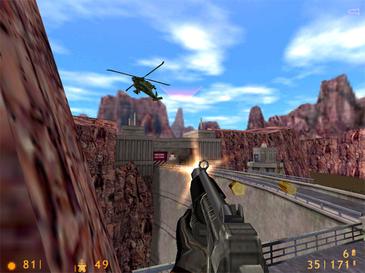
Half Life features a variety of ways to kill whatever's in your way.

A friend of mine once asked me why the Half Life series was so important. This is a fair question since, at first glance, both games appear to just be run-of-the-mill shooters. You're a silent protagonist, you have guns, there's things that need shooting, all pretty standard. I think a lot of Half Life's importance comes from context, specifically the state of the industry and shooters in particular when the first game came out.

Shooters had been around for a while before Half Life was released. The most notable FPS was Wolfenstein back in 1992, but there's evidence of the genre even before that. 1993's Doom was really where shooters hit their mark, insofar as, for the longest time, FPS games were just refered to as "Doom clones" a not unfair moniker since that's exactly what they were. Every shooter was just another version of Doom, albiet with some stand outs like Duke Nukem 3d, Rise of the Triad, or Blood. They were all just mindless shooters that sent you through barely connected levels with little to no overarching plot. John Carmack co-founder of Id software and creator of Wolfenstein and Doom has famously said "Story in a game is like a story in a porn movie. It's expected to be there, but it's not that important." For the longest time that was the attitude, games, especially shooters, didn't need a plot as long as they were fun. Then someone opened the Valve. 

1998


http://upload.wikimedia.org/wikipedia/en/6/65/Halflife_ingame.jpg

Gordon Freeman may be a man of science, but his skill with a gun is what keeps him alive.

Founded by ex-Microsoft employees Mike Harrington and Gabe Newell, Valve's first game was to be a sci-fi horror game based on the Unreal 2 engine, developed for Seirra Online. Based loosely around the setup from Stephen King's The Mist, the game centered around a military base that accidentally creates a portal to another dimension, ushering an apocalypse. After being shown at the 1997 E3 expo, the game was finally released in late 1998. 

Half Life blew people away. For the first time, the player was given context for their action, and a reason to move forward other then "because that's where the enemies are". Half Life features no cut scenes, and it's protagonist Gordon Freeman never speaks, allowing the player to become fully immersed and imagine themselves as Gordon Freeman. There's no better example of this then the YouTube comedy series Mind of Freeman. 


This was truly a far cry from other shooters at the time. People simply hadn't heard of a shooter having a plot, and scripted cinematic events weren't common in FPS. No a days this is common practice, with Battlefield or COD hedging their entire single player campaigns on big set piece moments, but back then it was fresh and new. 


Graphically, the original Half Life doesn't quiet hold up. It's blocky, jagged, and low res, and it's lighting engine is a joke. There was a re-release onto the new Source engine a few years back that added several effects, but the real way to replay Half Life is through the fantastic Black Mesa fan made game. It's unfortunate that Black Mesa isn't complete, but it's free and the developers are promising a complete version soon. 


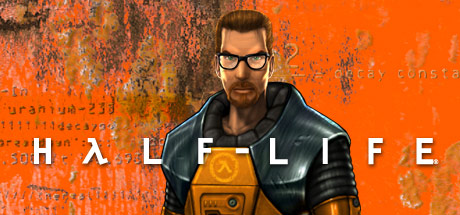
It's worth talking about Half Life's main character Gordon Freeman. Like everything else in Half Life, Freeman is a break away from conventional gaming heroes. He's not a super soldier, a space marine, or even that good with a gun. Gordon Freeman is just a guy, with a hazard suit, and he just wants to survive. He's a scientist, driven by the desire to explain the unexplained, and when he accidentally creates the apocalypse, it's just because he's doing his job.  


Opposing Forces


http://cdn.akamai.steamstatic.com/steam/apps/50/header.jpg?t=1414620270


A little over a year after Half Life's release an expansion pack called Opposing Forces came out. The title is apt, as you play as one of the many soldiers sent to kill Freeman and shut Black Mesa down. Everything goes awry fast and you end up stranded, fighting the aliens and trying to escape with everyone else. 


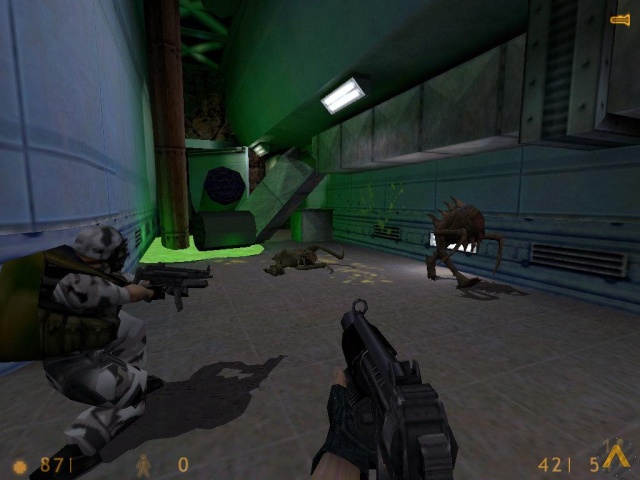
Opposing Forces was something of a tonal shift from the original Half Life. Where as the vanilla game was largely about exploration with combat on top, Opposing Forces was a much more action oriented game, with constant gunfights every moment. To facilitate this is the expanded roster of weapons, as well as protagonist Adrian Shepard's ability to recruit soldiers to fight with him. 


http://media.moddb.com/images/games/1/13/12118/Half-OF.jpg

As Adrian Shepard, you'll need all the help you can get.

For what it is, Opposing forces is a fine expansion pack. It take much of what made the original great, and builds on it with new ideas. It's a great example of what expansion packs used to be about. 


Blue Shift


http://cdn.akamai.steamstatic.com/steam/apps/130/header.jpg?t=1364932044

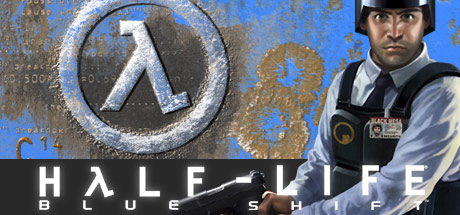
In 2001, three years after the original Half Life, the second expansion pack Blue Shift was released. Unlike Opposing Forces, Blue Shift made several changes to Half Life's formula. As security guard Barney Calhoun, you aren't equipped with the electrically powered hazard suit Freeman or Shepard have. Prolonged gunfights drain your armor quickly, and the only way to replenish it is scavenging.

Blue shift wasn't bad, but it was disappointing. In the three years since the original Half Life's release other, better shooters had started to come along, and Blue Shift simply couldn't hold up. 


http://img2.wikia.nocookie.net/__cb20100211121103/half-life/en/images/2/21/Ba_power10029.jpg

You'll have to be quick on your feet or end up like this guy

When Half Life was ported over to the PS2 another expansion pack was released called Decay. This one featured co-op play, and a larger focus on puzzle solving. It's possible this would seed the idea of Portal 2's co-op later. Decay isn't really considered cannon, so that's all I'll say on that. 

Legacy


http://assets.vr-zone.net/17115/Pcpp_jan2010_02.jpg

The fantastic Black Mesa Mod, bringing Half Life into the 21st century.

Half Life remains as one of the most influential shooters ever released, for good or bad. It's scripted linear progression and focus on telling a story have changed the way shooters play even today. Perhaps as equally important was it's modding ability, creating the massively popular Counter Strike and Team Fortress games, as well as a number of other excellent single and multi play games. 


There's no denying Half Life's greatness, and even today through the Source re-release or the wonderful Black Mesa Mod it's a fun game. It's one of the greatest shooters ever released, and there was only way way to make it better.