Showing posts with label Dark. Show all posts

Wednesday, April 22, 2015

Looking at: Dark Souls 2


The Old Guard

The odds will often be stacked against you, you'll need patience to get through.

The first Dark Souls has been called a masterpiece, one of the most important games ever released, and one of the best RPG games ever made. Accolades have been heaped on it for nearly every aspect, from the brutal difficulty, open ended nature, interconnected world, and sparsely told plot threads. Indeed, between the PS3 version and the PC re-release (which was recently FINALLY moved off of the terrible Games for Windows Live) I've put dozens up dozens of hours into fighting and dying in Lordran. Clearly a sequel was inevitable, and early 2014, Dark Souls 2 was released upon us. Is this a dungeon worth delving, or was this death in vain?

The Darker Soul

occasionally you'll have a chance to indulge your inner firebug to solve puzzles.

Like it's predecessors, Dark Souls 2 is a game about dying, fighting, and dying some more. You've come to the land of Dranglaic to seek treasure and fortune and have instead become cursed to stay there forever, trapped between life and death. To heal yourself you'll need to kill the four guardians and rekindle the primal fires before slaying the land's monarch and claiming the throne. In order to do this you'll suffer through a series of challenges killing all sorts of monsters and bosses along the way in your campaign of destruction.

DS2, like Dark Souls and Demon's Souls before it, keeps it's plot purposely obfuscated, and likes to deal out small amounts of plot or lore through background osmosis, rather then hand it to you straight up. It's easy to miss the entire plot of DS2 and you'll often need multiple play throughs to understand some of the finer points of the lore. It's not that the game is poorly written, quite the opposite as there's a wealth of backstory to be found if you go looking for it. Rather DS2 is content in letting you piece together the world yourself, giving you the ability to do this and letting you figure it out. It can be disorienting at times, as you try and figure out what your goal is, but it's oddly refreshing in the face of modern games that just give you everything without leaving anything to the imagination.


Killing in the Name

Fighting with others can make any challenge just that much easier to handle.

This idea of letting you figure things out extends out to the gameplay. DS2 is a tough game, but it's a malleable game as well. Theoretically the entire game can be beaten with the starting equipement, as long as you get good enough to work within that parameter. That's one of my favorite things about the Dark Souls games, is that despite their intense difficulty, you really can play whatever way you want. For instance, one of my characters was named Punchy Joe. He never wears shirts and only fights using a pair brass knuckles. Using this hilariously underpowered character I've cleared about a quarter of the game with minimal issues, all because I adapted to how to play differently.

That's the trick of DS2, is that you'll need to adapt to win. Every fight is memorable, from your first zombie swordsman at the start, to the elephant man I just killed 20 hours in. All of these are constantly fresh in my mind because they have to be if I want to succeed. I learned quickly that the elephant man's pike has a long range, so I learned to stay even further away, just like I learned that the swordman slashes twice then stabs. Learning from your mistakes is the only way forward in DS2, and lord knows you'll make a lot of mistakes.

There's another reason the fights in DS2 are memorable, and that's because like it's predecessor they often lean towards quality and less to quantity. A level might only have a few enemies in it, and some of the areas are so small you can see the end of them from the beginning. The trick is that you'll suffer for your finish, and while there may only be five enemies in your path, it'll take you forever to chip away at them. Fights like this are often the norm and it's rare to see you facing a crowd, save for one particular boss fight. You'll need to conduct fights like an opera, making sure to only fight what you can handle at any given time and leaving room for a quick pull from your healing flask or breaking open a slow-acting life stone.

Accidental Death 

There are some truly gorgeous vista, but they often hold untold horrors. 

DS2 is a bigger and more ambitious game then the first one, and while this means that certain aspects have been improved upon, there are also numerous parts of the game that just don't work as well as the first one did. There are more then a few issues that didn't come up as much in the first game and, while none of them are necessarily game breakers, they do dampen an otherwise fantastic experience.

The first and most notable issue is the enemy AI. Dark Soul's AI has always been problematic, ever since the first entry Demon's Souls. The enemies only know to charge you and use their set of attacks, and don't bother with self preservation. While that means you can occasionally draw enemies into traps meant to kill you, I noticed that their AI was particularly inconsistent in DS2, often teetering between devious and dumb, flanking me one minute and walking into my obvious attack the next. Even more inconsistent was how the enemies fought me, lunging straight past me with one attack only to stun-lock me with the next three strikes. The simplest foe became a mini-boss fight when he managed to get me into a corner with attacks I couldn't block.

That brings me to DS2's biggest issue over the first one: your ability to avoid damage. In Dark Souls avoiding damage was all about dodging or blocking. You either had to be quick with a roll or carry a good shield. Either way it was possible to make it through much of the game while avoiding damage, making the few times you did get winged all the more strenuous because of how much they hurt. In DS2 something feels... off with the whole ordeal and it's largely due to some tweaks to the hitbox detection. More then a few times I've noticed the game subtly adjusting enemy attack patterns just so to make sure their hit lands, and the dodge-roll seems to have far fewer invincibility-frames then the previous game. You'll get hurt a lot in DS2, and sometimes it doesn't feel like a fair fight because of it.

Japanese Gothic

Each new area is introduced as you step into it, inviting you to explore it's secrets. 

Levels in Dark Souls had this interwoven feel to it, like the whole world was slowly unfolding before your eyes as you explored. Even with the most bizarre areas there was a logical progression to it all and there were plenty of secret passages and shortcuts to uncover. The world wasn't all that large on reflection, but what it lacked in size it made up for in spades with it's detail.

DS2's world is bigger sure, and there's a lot more to do, but all of this comes at the cost of logic and reason. There's an abundance of pointless areas that serve nothing more then to transition you from one dungeon to another, and the flow of the game often doesn't make much sense. Why does a ruined tower lead me to an underground shipyard? Why does a mining town lead me to a volcano fortress? It's confusing and seems much more piecemeal then the first game, like the levels were designed separate then made to fit regardless. The individual levels themselves are great, offering challenges and puzzles galore and are often a joy to explore, but getting between them often feels boring and it's a good thing fast travel is unlocked from the start.

Graphically DS2 is impressive, albeit not as good as it's own E3 trailer some time ago. The lighting does a good job of selling the somber and dark mood, while obfuscating traps or enemies. The texture work is decent, although falls apart upon closer inspection, and everything has a purposely ugly and ruined look to it. The various pieces of equipment all look fantastic and unique from each other, and there's a myriad of ways to make your character stand out, from the crazed jester to the noble knight and anything in between.

The audio work is similarly well done, with a great soundtrack of dark and moody music, just quiet enough to fit any scene while just loud enough to be heard over the clang of weapons. Weapons all have a distinct sound to them and everything from tearing through flesh and armor to smashing down doors sounds weighty and bombastic. Enemies often have their own unique soundbites letting you know their around the next corner, but rarely giving them away.

There's only a small handful of friendly NPC's to talk to, but the voice work is decent enough. They manage to sell their lines, often with an air of uncertainty, either about you or their current predicament. More entertaining are the souls completely lost to the madness who really just have fun with their characters. There's no one as charming as Solair or Patches, but the characters of DS2 are memorable enough. It's especially handy that the majority of them move to the central town during the story, meaning they're easy to track down and talk to again.

Mass Grave

You're not really the hero, more of a janitor come to clean up the mess. 

Multiplayer returns in DS2, largely unchanged from the first game. You'll be able to summon other players to your world, or be summoned to other worlds, through the use of in-game items, allowing you to team up and take down bosses. The changes this time are in how the humanity system works. In DS2 you can turn human at any time, no longer reliant on bonfires to do so, but the trade is that every death while not human lowers your overall health, down to a possible half bar. This makes staying human that much more important as you'll often need as much HP as possible, even just for the purposes of exploring.

The other big change in terms of multiplayer is the idea of Souls Memory. Rather then lock multiplayer summoning to a certain level range, it's now based on your soul memory, that is, the total accumulation of souls (in-game universal currency) you've gained with your character. That means a level 80 character can play with a level 20 character, so long as they're both in the same Soul Memory Bracket. It's a bit confusing at first, but it simultaneously makes it easier and harder to play with people, based on how much of the game they've played as well.

Once again, DS2's multiplayer is an all-or-nothing game, meaning that if you want to play with other people you'll also have to be willing to allow other players to invade your game. These encounters are often both the best and worst part of the game as I lost count of how many times I was backstabbed because of a bad connection between me and the invader. There is now an option to play offline hidden within the game, but it removes much of the best parts, meaning you'll have to take the good with the bad.

Sins of the First Scholar

The Pursuer Knight, a formidable foe that will chase you throughout the game.

The original DS2 came out in early 2014, and was a moderate success. There were three DLC packs released, each containing a new dungeon with new challenges and items. Seeing as it's 2015 and publishers are money sucking scum, DS2 has received the HD update/game of the year treatment in the form of Sins of the First Scholar. This version collects DS2 and all of it's DLC while changing the graphics over to DirectX 11 and changing up enemy placement for a new challenge.

Right off the bat the best thing about SotFS is the 60fps lock. I've never been one to get into arguments about frame rates, but it's undeniable how much better DS2 plays at 60fps. It's a fast and fluid experience that really enhances the experience. There is some concern about weapon durability falling faster due to a glitch, but From software have already promised to fix that in an upcoming patch.

As for the new enemy placement, while it does balance out certain areas, From seem to have made the same mistake as Hotline Miami 2 thinking that more enemies equals a better challenge. It's unfortunate to see a game like this take such a terrible misstep and while it never ruins the game, it does make certain areas feel like a slog rather then proper challenge. Worse, with some of the new challenge it's difficult to recommend SotFS to a new player, despite the upgrades and multiplayer stability because the level of difficulty in some areas goes above and beyond to be annoying.  It's not a bad upgrade and I'm glad I got it, but it doesn't really do the Dark Souls name proper justice.

Dead and Buried


From shaded forest to rain slicked fortresses, DS2 is a big game.

It's unfortunate that Dark Souls has earned a reputation as one of the most difficult games ever made for a few reasons: First, it means that any half-baked indie game promising a challenge refers to itself as "Dark Souls-like". Secondly, it's just not true. Sure, there is a challenge to the Dark Souls games, but only if you fail to adapt to the game and begin to play with it as it would you. Dark Souls isn't just a game to be beaten, it's a game that dares you to embarrass it, make it feel sorry for ever trying to pick a fight with you. That's when it's at it's best and you truly begin to enjoy it.

I've never liked the idea that a sequel cannot be better then the original game, and saying a sequel isn't good because it's not the original annoys me. Unfortunately, that's simply not the case with DS2, as it's just not as good of a game as the original was. Maybe if it had the original director, or maybe if AI scripting was just a little bit better, or even if the levels were a little more concise this would be a better game. The fact is DS2 just has a few to many issues with it, and that's what keeps it down. Still it's still one of the best RPG's in recent memory, and definitely worth playing for anyone looking for a great challenge. At the very least, it's more Dark Souls, and that's exactly what I wanted.

Wednesday, February 18, 2015

Looking at: Max Payne 3


What's in a Name?


From it's opening moments, Max Payne 3 promises explosive action.

Max Payne is likely the most aptly named character in video games, save perhaps the actual characters of War and Death in the Darksider series. Despite his relative humble beginnings, Max is a man who's only real skill is in dealing pain and death to anyone in his way. For his third outing Max decides to take his unique brand of justice to the crime filled streets of Sao Paulo in one of the bloodiest, angriest action games I've ever played.

The Max Payne series has never received as much attention as some other classic games, perhaps owing to the fact that despite being in existence for over ten years there's only three games in the entire series. The first game, released in 2001 by Remedy (who would later go on to make the Alan Wake series) was an interesting break from other games of the time, with the dark noir story of Max's struggle do deal with his murdered wife and daughter. The second game in 2003 saw Max now dealing with forces much larger then him as he attempted to aid the fem fatale Mona Sax in her quest for answers.

The IP lay dormant for some time as Rockstar and Remedy parted ways, but finally Max returned to the small screen in 2012, this time courtesy of Rockstar themselves and despite sharing the same name, this was a whole new game.

Dime-store Angel of Death


Dynamic comic-book panels break up the numerous cutscenes.

If you didn't play Max Payne 1&2 don't worry, as the events of those two games are barely referenced at all, and it's clear that Rockstar were distancing the series from the original games. The set up is that Max is a disgraced former NYPD officer turned alcoholic, and has found work as a private security guard for one of the wealthiest families in Sao Paulo, Brazil. Things quickly go wrong as the family is repeatedly targeted and kidnapped by a local gang called the Comando Sombra and Max finds himself fighting a seemingly endless roundabout of people trying to kill him.

It's a dark and twisted story, owing much to the noir films of old. Max is older, angrier and almost suicidal throughout the experience and shows a lot more character then in the older games. This is helped by a great performance from James McCaffrey, who also provided the mo-cap for Max. All around the production value is Rockstar's normal quality of absolutely astounding with top quality acting and motion capture all around.

It's the character of Max that's likely the most interesting part of Max Payne 3. Like I said, this Max is older and angrier, and his inner demons have certainly done an impressive number on his psyche. He's a pill-popping drunk, and a few years of inactivity has put some meat on his once athletic body. There's more then a few grey hairs on his head, at least before he shaves it all off, and his beard is a tell-tale sign of a man that no longer takes care of himself. This is Max Payne for the new decade, tired of everything around him and constantly wishing that the next bullet will put him out of his misery.

Payne Killer


A moment of relative peace in Max's turbulent travels.

Make no mistake, there will be a lot of bullets. Payne attracts more unwanted attention then most other protagonists combined and despite it's noir narrative this is one of the most action-heavy shooters in a long time. Exact numbers are hard to come by, but it's estimated that throughout the 8-10 hour campaign you'll gun down north of 500 people, all in gruesome detail. You'll blow up cars, drive boats, and most importantly, fling yourself around in unscripted John Woo-esque slow motion dives to score fatal headshots and avoid enemy fire.

Rockstar has stated that they've purposely never made a first person shooter (prior to GTA V HD), and they consider Max Payne the closest they've ever gotten. What that means is that Max Payne 3 is, without any doubt, one of the smoothest, most fluid third person shooters I've ever played. Few games ever achieve the type of action that Max Payne 3 creates and, with very few exceptions, the game is able to constantly deliver damn near perfect gameplay. Everything in Max Payne 3 works flawlessly, whether it's popping out from behind cover to take down an enemy or flinging yourself through the air.

You'll do a lot of flinging, probably more then Max's body should be able to take. You'll do this because it slows time to a crawl and lets you score headshots. You'll do this because you'll constantly need to avoid enemy fire to stay alive. You'll do this because god DAMN it looks cool to spray bullets as you descend from the heavens like a heavily armed messiah. Bullet Time has always been a trademark of the Payne series and here it's reached it's absolute pinnacle. Despite the cover system in place I often found myself lunging towards waves of enemies, taking them head on as I rolled around the geography returning fire with ease.

Facilitating this constant flinging in Rockstar's in-house animation and physics engine, appropriately named the RAGE engine. RAGE first saw use in GTA IV, but here it's been refined to perfection, with frighteningly realistic animations. While the animations and physics on Max looks great, the engine really shines in the firefights, where it creates constant cinematic experiences dynamically.

Elite Squad


Throughout the game Max remarks on the divide between rich and poor in Brazil.

That's the key word in Max Payne 3: Cinematic. This is cinematic gaming at it's absolute best, never sacrificing the actual game for the movie-like experience. Max Payne 3 constantly feels like a high end action film in the best way possible, something like The Raid or John Wick. Not to dumb, but simple enough to understand.

Problematically, this leads to some of Max Payne 3's biggest issues. First and foremost is the linearity of the game. I'm all for a straight-forward game sure, but Max Payne 3 is linear almost to a fault, occasionally actively discouraging any exploration with Max himself chiding you for taking to long. There is a bit or replayability, thanks to the included arcade mode and hidden collectibles, but you'd be forgiven for only playing this game once.

There are other stumbles, like occasional glitches in animation. The worst one is during a last stand, where you're given one chance to kill the man that shot you in return for a second chance at life, the camera becomes locked and you won't be able to actually hit your target. It's a bit hard to explain, but if it happens it can ruin a good run.

Max Payne's pacing is also all over the place, acting like less of a rollercoaster and more of a ship at sea caught between several separate storms at once. The story makes like Max himself and constantly flings itself in several directions, ranging from Hollywood action to morose self reflection in just seconds time. It's jarring, and maybe in a certain light refreshing, but newcomers to the series might not get what's happening and can be turned off.

Long Hard Goodbye. 


Max is constantly living in a world of shifting shades of grey, with almost no real moral compass.

Max Payne may not have received the following some of his early 2000's counterparts did. No one cos-plays as Max Payne and there hasn't been a slew of sequels. But none of that really matters because Max Payne is a fun, enjoyable, and interesting game to play and stands a reminder of why Rockstar is considered one of the best developers in the industry.

Max Payne is shooting perfection, and a rare type of game in today's market. With a strong script, great voice work, excellent animation and visuals, and explosive action, Max Payne 3 is a game that reminds me why I like games so much. It's a hard-boiled, no-nonsense game and it's a hell of a good time.

Thursday, November 27, 2014

Looking at: This War of Mine

http://static.gamespot.com/uploads/original/78/787590/2484913-this_war_of_mine_screen_03.gif


Right Shift.


In a world post-Dead Island, I rarely trust video game trailers anymore. So many times have the games failed to deliver even the slightest bit of what the trailer promises that I've just become jaded to the whole thing. This War of Mine is a bit different through. No, the game doesn't involve a protracted gunfight in a ruined city street, but rather the cinematography of the trailer is what really sells TWoM, the entire game is a subtle shift off-screen.

I've always wondered what goes on just out of frame, be it in film or picture. With video games you rarely have to wonder, since most games give you free reign of the camera. But do they really? Think about the Call of Duty franchise for example. Sure, you have free reign over what you're looking at, but you don't decide what you see. Following their inclusion into the series in COD: MW2, civilians appear in almost every COD, but they're only there as moving distraction, part of the scenery. Other shooters are the same, with the game only showing what you and your team mates are up to. TWoM is a shift right, the camera has been knocked over, and now we're looking at what's usually off screen.

Black, White, Red.

http://static.gog.com/upload/images/2014/11/a213d1ed29489db6091405275cc541334c30c8d4.jpg

Nights are spent scavenging, and hoping no one else is. =

Everything about TWoM is a tonal shift, from it's subject matter down to it's graphical representation. The plot, as much as there is one, is you are in control of three survivors in an unnamed middle European country in the midst of a civil war. Your city is under siege and there's no escape. Indeed, there is no escape from anything in TWoM, and you'll send your small group through hell and back to see them to the other side. It's a game about survival, but it's more about what your willing to do to survive.

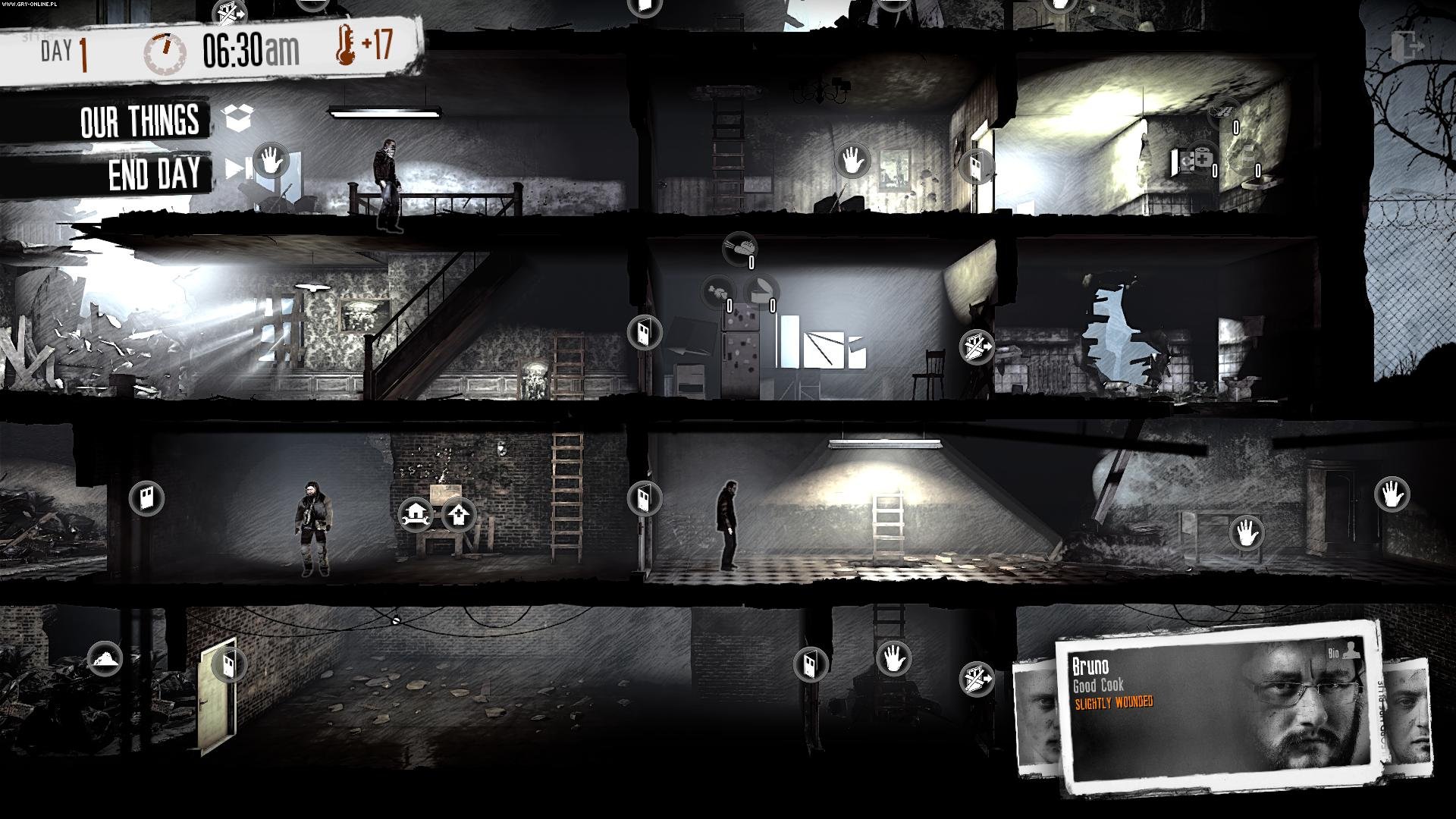
You'll have to worry about food, warmth, and everyone's health on a daily basis. The game starts a little easy, with at least a few days of relative heat, so you'll only worry about food. There's two phases, day and night. During the day you're confined to your shelter, and will spend time prepping food, making furniture, and crafting tools and weapons. During the night, one person will run out and scavenge while the others either stand guard or sleep. What happens back home is randomized, some nights it'll be quite, some nights you'll be attacked, and it all falls on your guards to sort the situation out.

Scavenging is one of the more interesting parts of the game, since it's the part where you'll have the most direct control over what's happening. You take command of the scavenger and direct them to loot locations. Sometimes you'll need to overcome obstacles, and sometimes you'll meet other survivors. These encounters are some of the more interesting parts of the game, as you can choose how to go about them in a variety of ways. The obvious answer is to run away, but this means you don't get any supplies, and food and medicine is almost always guarded. If you have goods to trade you can occasionally set up trades, offering useless items or items you have in excess in exchange for goods.

Both Sides.

http://i0.wp.com/apgnation.com/wp-content/uploads/2014/11/2014-11-11_00010.jpg?resize=820%2C461

Other people are often your biggest obstacle.

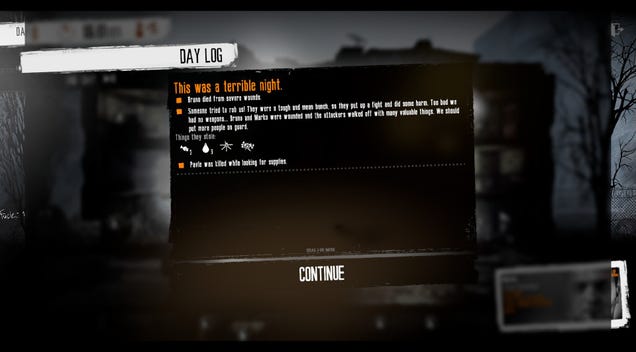
When stealth or peaceful discord fails there's always option three. This is where TWoM really goes for the emotional gutpunch. See, you can just kill anyone in your way, and occasionally violence is the only answer. But a lot of survivors you meet are just like you, trying to get through with meager belongings and barely a roof over their heads. Worse is that robbing and killing people will affect your characters. Doing deplorable actions can make people depressed, and eventually break them mentally. having one of your survivors killed can be ruinous to moral sending everyone into a deep depression.

It creates an interesting balance of "how deep am I willing to go to survive?" that we don't often see portrayed in games. TWoM is easily one of the darkest games I've played in some time, approaching The Walking Dead or Spec Ops: The Line levels of human reflection. There are no monsters in TWoM, only people trying to survive.

The Line Blurs.

http://mousenjoypad.com/wp-content/uploads/2014/11/356417917.jpg

Your home base, which can be upgraded over time.

To reinforce this is TWoM's striking visual style. The game looks like pencil sketches, with wavering lines and shades of black and grey. It's a great look and helps to sell the dark tone of the subject matter. At night the game looks great, with the darkness being an ever present entity, both friend and foe. Despite this look, things are easy to distinguish, and this is all helped by great UI tool tips that highlight items you can interact with.

What's perhaps most divisive about TWoM is how enjoyable it is. One the one hand it's an easy to play game, with plenty to keep busy with, and great moments of tension creating a rollercoaster of emotion. On the other hand, it's quite boring and repatative, with only a handful of items to make and no real direction or goal. The real question is whether a game with a message like this should be considered fun.

Spec Ops: The Line has often been praised for it's story and characters, but it's never received praise for being fun. Gone Home, for whatever reason, has received praise for it's presentation and story telling, but it's not been called fun. This creates the debate of should games with a message to them be fun? Does a game need to be enjoyable to play when it's trying to tell you something? It's like dressing a minister in a clown costume and asking him to do a sermon on the book of Job. Can he deliver his message? Probably, but we might not take him seriously while he's doing it.

For what it's worth, I think TWoM is enjoyable to play. It's really simple and easy to get into, and don't be surprised if there's an android/IOS port in the very near future. It's all mouse based, and the UI is just useful enough to make this not a hassle.

Gimme Shelter.

http://i.kinja-img.com/gawker-media/image/upload/s--FYqNUW5P--/c_fit,fl_progressive,q_80,w_636/bzu9sejvggbm83v4bjon.jpg

Coming back to a looted shelter can be a nail in the coffin for your group.

TWoM obviously comes from a very personal place. It's examination of war is so in depth that most games simply don't compare. It's inspired by true events from the Siege of Sarenjevo, and the stories from that have really shaped the game's experience. There are some issues with TWoM however. It's lack of tutorials means that the barrier to entry can be high, and this is made harsher by the random nature of the game. My first game I started with no food at all, and it took some time for me to figure out how to get some. The pacing is often painfully slow, and while you can skip straight to the night sections, this is rarely encouraged since you risk wasting a the entire day. The game is also brutally tough, although I hesitate to complain about this since it's supposed to be difficult.

This War of Mine is an interesting game, and for once it's an indie game with a message that isn't horrible or un-enjoyable. There's a legitimately good game here, and it's foundation is strong enough to make playing it fun. It's a game with a message that remembers that it's a game, and it's refreshing to see. It might not change anyone like Spec Ops: The Line did, but it's a great game with some great stories to tell.