Tuesday, August 4, 2015

looking at: Ridge Racer: Unbounded


Unsullied

cars only seem to ever come in one paint colour.
The nice thing about racing games is that you really only have to play them for about an hour or so to figure out what's going on with them. At least, that's the justification I'm going to use to write this review because honestly, after an hour I just don't want to play Ridge Racer: Unbounded anymore. This is easily one of the worst racing games I've ever played.

This is the first racing game I've reviewed here at LAATIAB, so I want to set a precedent here: I like racing games and racing simulation games. I love Mario Kart, Burnout: Paradise, and I really enjoyed GRID 2. I've played more Need for Speed games than I can remember, and I've likely logged over a 100 hours in Burnout 3 for the Xbox as a kid. I like racing games, I get racing games, and playing racing games is usually a good time for me.

Unless it's Ridge Racer: Unbounded.

Which is a stupid fucking name.

Off the Ridge

smashing through obstacles will give you shortcuts, often in the form of ramps.
The Ridge Racer series is huge, and stretches back to the early 90's as Japanese arcade and console games. Some of the old games are extremely well liked, and many of the PS2 entries in the series top out that console's best racing games list, no easy task considering some of the other games on that list. I can't say I've played any previous RR games, so it's perhaps unfortunate that Unbounded is my first experience.

This is the thirteenth console entry into the series, and by it's own description it breaks away from some of the conventions of it's predecessors. Judging by my experience with it, that number is rather unlucky, despite the pedigree going into it. Not even Bugbear, the company behind Flatout 2 or the upcoming Wreckfest could save this wreck.

Let's start off with what works. Graphically, RR:U is pretty good looking. There's an odd orange filter on everything, but reflections look good and the cars all look great, even at high speed. Even at high speeds my framerate was really good, and it's an overall decently optimized game. There's almost no graphics options whatsoever, so you better hope your system can run it.

The other thing I liked about RR:U was the idea of destructible terrain. This is something Bugbear seems to have taken from their Flatout games, and here they've gone above and beyond. Tracks will have destruction points that you can boost into, provided you have some boost saved, to create shortcuts or destroy several opponents at once. These are hugely satisfying to activate and I went out of my way to try and activate them if I could.

Cliff Diver

The game looks great, to bad it's all for naught.
Ok, that's the good, here comes the bad. That is, pretty much everything else.

First, and probably most importantly, are my issues with the controls. The actual layout was ok, but controlling the cars themselves was a chore. I wasn't stupid enough to try to play the game on my mouse and keyboard, but on a controller cars felt sluggish, and unwieldy. Trying to drift was a death sentence, and more often then not resulted in my completely spinning out, unable to recover easily and moving me way down the rankings.

I really want to make sure you understand how bad this drifting is. It's hard to explain accurately in words, or even video, and the only thing I can suggest is playing a really good racer, like Burnout: Paradise, then playing RR:U and you should instantly understand. Trying to use the handbrake as suggested by the game was a no-go, as it would send my spinning like a top. Trying to use the brake peddle wasn't much better because it didn't do anything to slow me down. Trying to take a turn well in RR:U was nearly impossible, and I'd either end up sliding into a wall or spinning out.

This all brings me to my second issue, the game is fucking hard. Coming from Namco Bandai, I was actually surprised not to see From Software's name on it, since it feels like it would fit in perfectly with their Dark Souls series. The AI kicked my ass, no matter what car I used or how I changed my tactics. It took me four tries to beat the first race, and subsequent races took even longer, to the point where I gave up completely to write this. I don't know if it's weird rubber-banding, or the bad controls, or both, but I was just never able to create a solid lead, the few times I did manage to get ahead.

Cars feel sluggish and unresponsive.
Maybe it's because all of the cars are just awful. It's usual for the starting cars in a racer to be junkers, everyone expects that. You have to earn the better cars, either by earning money and buying them or unlocking them through challenge. But it seemed like non of the AI had any problem, and they all started with top of the line racing machines while I was stuck with 1995 Oldsmobile Royal 88. Loosing a race still gives you XP that's used to unlock new cars, so maybe if I had farmed the same failure over and over eventually I could have placed, but that's a bad way to structure a racer.

Sound effects weren't bad, you could hear the rumble of the engines and the sound of squealing tires, but the music was just annoying. As far as I could tell there wasn't any licensed music anywhere in the game, likely because between EA and anyone else competent a lot of music was taken. Instead there's just endless techno music that made me feel like I was in a shitty nightclub with people I didn't like being around. There's no option to supplement your own soundtrack either, so if club music isn't your scene you'll need to alt-tab out to not want to kill yourself.

The map making feature is powerful and simple to use.


Mechanical Failure

This happened every login attempt.
Maybe one day I'll review a good racer here on this blog. I hope so, because there are a lot of racing games I really like, just this one wasn't one of them. It's worth noting that there are. or rather were, multiplayer features. I say "were" because every attempt to log into the RR:U servers failed instantly. The game is on sale right now, so it's possible the servers are overloaded, and you could still play single-player just fine, but I think the servers are probably just offline and no one is playing this game.

There's also a track creation tool that's actually pretty cool. It reminded me a lot of the create-a-park modes from old Tony Hawk games, only for race tracks. There's a lot of room to play around with it, and you can create some cool tracks, but it's nothing we haven't seen from Ubisoft's superior TrackMania series, and doesn't have nearly the visual charm.

Ridge Racer: Unbounded has the distinct honour of being one of the worst racers I've ever played. At least Diddy Kong Racing on N64 had a charm factor, but RR:U is just a bad, poorly made, and un-fun racer that pales in comparison to better racers. When it comes to fun racing games, this one doesn't even cross the start.

Friday, July 31, 2015

Looking at: Lords of the Fallen


Imitation...

Conversation trees are a nice addition, but they don't do much to change the game.
Ok, let's get this out of the way right now. LotF is a blatant, BLATANT attempt to ape the tough-as-nails style of the Souls series From software have previously released. We all on the same page on that? Great.

It's ballsy for a game to attempt to be another game, and it's even ballsier to try and take on a series as well loved as the Souls games. Does LotF live up to it's Eastern cousin, or is this one death not worth respawning from?

Long Winded

Plenty of armor and weapons choices allow you to customize Harkyn however you want.
The setup for LotF is that you are Harkyn, a former prisoner that's been gang-pressed into service as part of an expedition to a remote abbey. The abbey is over-run with demonic creatures known as Rhogar, and it's up to you to stop their incursion and push them back to their world, pretty much single-handily. There's some minor twists that you'll see coming a mile away, and some choices that change the outcome, but it's all fairly straight forward and delivered in such a blunt manner that it's impossible not to follow.

This sort of sets the tone for LofF's attempt to mimick the Souls series, and it's repeated failures, often spectacularly. Where the Souls games were always content to drip-feed story through the use of item description and background details, LotF fires the plot at you double barreled and makes damn sure you know what's going on through repeated use of cut-scenes and dialogue trees, two things the Souls games have almost none of.

The issue with all of this is that the story isn't good, in fact it's pretty awful. I had to look up the main character's name since they don't say it in-game for a few hours, and I couldn't even tell you any of the other character's names. Compare that to Dark Souls' roster of memorable characters like Patches, Andre the Blacksmith, or the Knight Solaire and it just falls completely flat. Even with the addition of player choice, the plot never goes anywhere interesting, and what should serve as justification for your actions just gets in the way and slows the experience down.

Slow and Steady

Bosses are truly grotesque, and show some great creepy design.
Not that the gameplay itself keeps up a good pace. LotF is an incredibly slow and tedious game to play, even when using a light equipment set. Harkyn moves like a brick shithouse, and the weapon animations are so slow you'll need to add a few seconds to whatever mental math you're working out in combat. Not all weapons, mind you, just the ones that do any damage whatsoever to the spongey enemies that plague your path. Just walking around, even in light or medium armor, felt sluggish, and it's a damn good thing the levels in LotF are so small because trying to move Harkyn across a huge open field would be a worthy test of patience.

Enemies themselves don't really help at all. They're well designed, sure, with some really grotesque looking abominations bolstering the ranks, but there's an overall lack of variety to them, and even several hours in I was still facing off against literally the first enemy in the game. Worse, is that the enemy design and combat in general seem to aim more to annoy rather then challenge. Enemies don't always alert you of their attacks, and so, so many attacks either stun-lock you or break your guard instantly. There are several enemies that instant-kill you no matter what, as well as enemies that attack using damage-over-time attacks that wear down your health. For every fair, well paced fight, there's three of so instances where the game throws a bunch of foes at you simultaneously, and the non-linear but-not-really design of the game means you can spend a lot of time and resources battling enemies that you don't need to because they're guarding a locked door reserved for several hours later.

That's the whole underlying issue with LotF, is that the whole thing is so goddamn aggravating, but with no payoff. I rarely felt good after defeating a tough enemy, and at best I'd feel exhausted and angry, not satisfied in any way. Bosses weren't challenging, they were just annoying, with some of the worst hit detection I've seen in a long time. There's a mid game boss that could bash me from across the arena, but his actual weak spot was smaller then my character's head. This wasn't an exception either, as I found hit detection to be a regular issue as my attacks flew through enemies, and things I was sure I dodged slammed into me full force.

Proper Gothic

Killing a boss does... something to Harkyn.
If there was one thing I liked about LotF, it's the art style. I'm a sucker for gothic looks, and LotF reminded me of Warhammer in the best way possible. Armor and weapon sets especially made me giddy, and I genuinely enjoyed the look and feel of the various equip-able items. It seemed like no matter what I put on Harkyn he always looked like an unstoppable badass, and that made me feel, briefly, like a badass myself.

Overall the game looks pretty decent. There's great smoke and lighting effects that help to sell to mood, and enemies look grotesque enough to make you want to kill them. The monastery itself looks proper old-school gothic, and the realm of the Roghar looks alien and frightening. Character models don't fare nearly as well, as they all look terrible, and lip synch was hilariously off, although I'm willing to be that's at least partially a translation issue from German to English.

Audio, however, doesn't help LotF at all. Weapons don't sound as weighty as they feel, especially because they're going so fucking slow it feels like they're made of bedrock. Clangs, smashes, and all other weapon sounds are just tinny and un-fulfilling. That's if they don't cut out randomly, like most of the other sound effects. It's particularly jarring when you walk through a door way and the super loud sound effect that was in the background a second ago just cuts out for no reason because you're now in a different area.

Voice work too, isn't great. There's nothing overly wrong with any of it, but it's all so bland and generic that I'm actually struggling to remember any one character that stood out. Harkyn is any gruff bald white dude voiced by Not-Nolan North/Troy Baker/Steve Blum/Roger Craig Smith. Other then that, there's a tough-as-nails action girl, some old dude, some other old dude that's obviously evil, and a host of righteous crusaders that make you want to hate them instantly.

Dialogue, like sound effects, cuts out randomly, and it reminded me in the worst way of The Witcher 2's endlessly repeating dialogue, only instead of running through an entire conversation a million times, this would be an instantaneous restart because my character moved an inch to the left of the dialogue's trigger area. Overall, LotF has some of the weakest sound design I've seen in a long time, and I eventually found myself just listening to music while playing the game, rather then suffering through the game itself.

...is the best form of flattery

The design looks like Warhammer in the best way.
I think, to a certain degree, I'm biased against LotF, because of my love and respect for the Dark Souls series. If the intentions of the developers were to just simply ape From's masterpiece, then it's a noble attempt. They even tried to change things up, like how the longer you go without using a checkpoint the higher your XP multiplier gets, creating a risk/reward system as you move forward. And, compared to most other modern RPGs, LotF at least tries to challenge you, rather then giving you the world on a silver platter, it makes you fight for your fun.

But it's a fun not worth fighting for, and it's a world not worth saving. The worst part of LotF is that playing it just made me want to go back to playing Dark Souls again. When your game is so mediocre that I'd rather just play a completely different game, then it's a game I'm going to forget about and never play again. At the end of the day, Lords of the Fallen just isn't as good, isn't as polished, and isn't nearly as enjoyable as Dark Souls is. Maybe they can solve that with the recently announced sequel, but for now this is one imitation that's not worthy of the original.

Sunday, July 26, 2015

Looking at: Dishonored


Arkane Knowledge

The art style of Dishonored is reminiscent of England in the 1600's, if they were drawn by Norman Rockwell
Creator of Deus Ex, Warren Spctor, once theorized a game that took place in a completely perfectly realized city block or apartment building. A game where everything was reactive to everything else, and every choice created a different outcome. Deus Ex explored this idea back in the mid 90's, but it's 2012's Dishonored that might be the closest to this idea we've ever seen.

Arkane Studios is a company who's work I love, but no one has heard of them. That's fair, since their catalog consists of four games: Arx Fatalis, Dark Messiah of Might and Magic, Dishonored, and the upcoming sequel to Dishonored. That's not exactly a great lineup, but whereas some companies need several games to get anything right, Arkane has always been great at making a specific kind of game, namely ones that give the player complete freedom withing enclosed spaces. Does Dishonored continue the grand tradition of open-ended stealth, or does this game deserve a dishonorable discharge?

Frame Job

The world is completely realized, right down to battling religions like the cult of the Outsider.
Dishonored is an open-ended stealth game in the same vein as the old Thief titles. No, not that Thief game, but the good ones, namely Thief and Thief 2. The levels are massive and exploration is encouraged as you search for cash, equipment, and upgrade schematics, all the while dealing with the guards in your way.

The important distinction between Dishonored and Thief is that Dishonored is all about killing people. Sort of. You play as Corvo, former body guard to an Empress who's been accused of her murder. Six months later, you break out of prison to exact revenge on those who wronged you, while trying to rescue the true heir to the throne, the Empress' daughter Emily. Along the way you'll interact with a variety of characters, and while the plot it self isn't anything great, the people you meet feel three dimensional and they all have believable motivations and quirks.

All of this is set during a city-crippling plague which has rendered everyone either dead or turned into a zombie-like weeper. Those who aren't diseased are battling over control of the rest of the city, tossing the whole of Dunwall into complete chaos. This servers a great background, as you enter into the picture on the outside fringes, and you're free to experience the city from all angles as you learn the truth about what happened to the Empress.

More important than the people you meet are the people you kill and, depending on how you approach Dishonored, that can be a lot of people. You are an assassin, and that means you're objective is, with one exception, killing anyone you need to, however you need to. It's in this idea that the true brilliance of Dishonored begins to shine through.

Death from Above, and Below, and Everywhere Else. 

Occasionally your grasp on reality loosens as your powers grow.
Dishonored has some of the most creative, and often hilarious ways of killing someone, thanks to the myriad of tools it provides you to complete your missions. Sure, you can just shoot and stab your way through, or you can stop time, posses a guard, and make him stand in front of his own bullet, or you can knock out one guard, attach a mine to him, then leave him as living bait. There are ways of killing people I still haven`t come up with after almost sixty hours of playing.

That`s the important thing in Dishonored, is the gameplay. It`s awesome. The controls are great, simplistic, and easy to learn, not to mention remapable on PC. The actual game itself is smooth as can be, and it's easy to feel like a complete badass as you zip around the city dispatching targets as you wish. It's fast and fluid, and combo-ing together jumps, slides, and the various powers feels amazing in a way that most stealth games can't match.

There are plenty of tools to use in order to complete your mission, and part of the fun of Dishonored is finding different ways to make them work together. You can re-wire enemy traps to work for you, use grenades and tripmines to eliminate groups of enemies in short order, or stick to your pistol or crossbow and keep some distance. Never mind the sword fighting itself, which is fast and fun, and requires just the right level of skill so actually taking down and enemy or group of enemies feels like a fair fight, provided your not slitting their throats from the shadows.

The gimmick in Dishonored is Corvo's bevy of skills, bolstered by the game's RPG system. The basic spell is blink, a short range teleportation that lets you move around the city free from the confines of the ground. There's other abilities too, like the power to possess any living creature, detect movement, blast wind, slow time, and summon a horde of rats. All of these are great on their own, but again it's finding out how to combo them together that makes them great, like slowing time, possessing a guard, and making him shoot himself, or summoning rats, then possessing one to get through a building grate. Combine this with bone charms that grant small bonuses to seemingly every act you can perform, and there's a good deal of customization to fit your need.

Intricate Skill

Chloe Grace Moretz as Lady Emily, likely the most important character in the game.
The other part of Dishonored that works well is the world itself, both mechanically and artistically. The city of Dunwall is a great big toybox for you to figure out, with crumbling towers, shadowy back alleys, and wide open streets for you to explore and exploit. Dishonored might not be an open-world game, but the levels it offers up are massive and beg for you to explore ever corner, every nook, and every cranny just in case you missed something.

Graphically Dishonored is serviceable. Nothing looks bad, but it's unfortunate how much of the game is static and unchanging. Lighting is great, but it never changes, an oddity in a stealth game, whereas games like Metro: Last Light or the Splinter Cell games always let you manipulate the lights to create shadows. Even the old Thief games had the infamous water arrows to let you dowse torches or firepits, so it's weird that Dishonored elected to have completely static lighting.

Where Dishonored makes up for this in spades is it's artistic direction, which is nothing short of amazing. It's sort of hard to describe the world of Dunwall, think Victorian England, by way of the Dutch West Indies, by way of George Orwell? That's sort of the best I can think of. Let me make this clear, this is not a steam-punk game, despite the mixture of medieval technology and more modern tech. Rather, it's something called whale-punk, specifically because all of the tech in Dunwall is powered by bio-luminescent and chemically unstable whale oil. The overall art direction is so completely weird and awesome that it needs to be experienced to understand.

Character models and animations fare well too. There's a lot of details in the various NPC's from the random people on the street to the disgusting weepers that wander the underground. It's unfortunate that's there's only a small handful of enemies to fight, but the one's on offer each have their own level of skill to contend with, and any more might have thrown off the balance of some fights.

On the audio front Dishonored does a great job of creating the city of Dunwall and bringing it to life. There's a lot of work put into the background sound effects of every small object, and the amount of reactionary audio, both in terms of clangs and bangs to actual dialogue is amazing. Speaking of dialogue, while the script might not always be amazing, the delivery is, with a massive voice cast including talent from Susan Sarandon, Lena Headey, Carrie Fisher, Chloe Grace Moretz, Michael Madsen, and Mad Men's John Slattery. All of them give great performances, and help sell their characters, but it's Grace Moretz as Princess Elizabeth that deserve particular mention for her great performance, making you really care about that character.

the most impressive thing about Dishonored is probably it's intricate subsystems that operate behind the scenes throughout the game. Dishonored tracks almost everything you do, and for every action there's a stat associated to it. Specifically how many people, innocent or otherwise, you choose to kill. Run around like a psycho and the world becomes dark and filled with horrors and disease. Choke people out and put them to sleep and Dunwall slowly starts to recover. There are five or so different ways to finish the game, ranging from not killing anyone, to killing everyone and their dogs, so replaying and finding new ways to abuse the system is encouraged.

Other Side of the Coin

Playing as the assassin Daud gives you a new perspective on the game.
As if the basic game wasn't great enough, Dishonored's DLC packs do it great justice by building on the already great ideas present in the vanilla game. In these adventures you play as Daud, an assassin that plays a major role in the main story, exploring his own path and mysteries parallel to the main game. The adjustments made for Daud are awesome, like a blink move that slows time, allowing for better control of your movement, or an expanded roster of non-lethal weapons. Most importantly, Daud speaks, unlike Corvo, making his story much easier to get into and follow, and creates better investment for the character.

There's another DLC that offers several challenges. It's fun enough and offers a good deal of challenge in order to unlock a three star rating, but it doesn't do anything new or exciting. It's similar to the Riddler challenges from the Batman Arkham games, and at the very least offers more Dishonored, which isn't a bad thing at all.

Dishonored is an incredibly rare breed of game, being a stealth action game that actually successfully offers stealth and action in equal measure. More then that, it's one of the most intricate and interactive games I've seen in a long time, letting you have fun with it, and even more fun breaking it. It hearkens back to games that made the stealth genre what it is, like Thief or Deus Ex, and as a spiritual successor to those titles it's amazing.

Dishonored is easily one of the best stealth games on the market today. It's fast, fluid, and fun beyond what the genre usually allows, and that's just enough to set it apart and above a lot of it's own competition. A sequel was announced at this year's E3 and I'm hoping it's going to address some of the minor issues found in the first game. Till then, I'm going to keep on blinking, stabbing, and absolutely breaking this amazing stealth adventure.


Saturday, July 18, 2015

Looking at: Metal Gear Solid: Ground Zero


Tech Demo


Skull Face, the mysterious villain haunting Snake
It's somewhat unfair to call MGS:GZ a full game, since it really isn't. No, I'm not saying it's along the line of Gone Home or Dear Esther, where it's not a game. It's full of gameplay, which is a little strange considering the MGS series is famous for having way to many cutscenes. No, MGS:GZ isn't a full game because it's clearly just a tech demo for the upcoming MGS:V, and that's not necessarily a bad thing.

Despite this, MGS:GZ does still offer a lot to do for what it is. In fairness, I only paid $13 for it, whereas it launched on consoles at a full $60. I can't say I'd pay that much for this product, but one of the advantages of doing so much of my gaming on PC is that I rarely have to.

Speaking of PC, this is actually a return to the platform for MGS, since the last several entries have been console releases only. How does it hold as a port, and more importantly, is it worth even playing?

Peaceful Walker


Side missions take place during the day, allowing you to see the camp a little better.
Being a short game, GZ has a shockingly normal story for the series. The setup takes place directly after Peace Walker and you once again play as Naked Snake, AKA Big Boss. Boss also showed up in my favorite MGS game (and the only one I've beaten so far) MGS 3: Snake Eater.

Being a sequel to these two games, GZ once again takes place in the past, specifically 1975. It's not quite as low-fi as Peace Walker or Snake Eater, but there's still no radar system and most of the technology you use is somewhat antiquted, from the older weapons to first gen night vision.

The whole game takes place in a secret US black-site operation on the tip of Cuba. Two characters from Peace Walker have been kidnapped and are being held for interrogation and Boss has decided to rescue them himself. All of this is happening during a UN inspection of Mother Base's recently acquired nuclear stockpile, lending an urgency to the mission.

Despite it's length, GZ does still allow for plenty of exposition, tying some loose ends from Peace Walker and setting up perfectly for MGS:V. It's not a big game, but it is important, and the story it tells has the telltale cinematic flair we've come to love and appreciate from Hideo Kojima.

Kept You Waiting


The entire camp is open for exploration, and offers plenty of places to hide.
Gameplay is the standard stealth action affair, emphasizing avoidance over direct confrontation. Your opponents this time are all US soldiers, and while Boss doesn't technically have a home, it does offer a grounded reason to resort to non-lethal combat.

I haven't played MGS:4, so I don't know how similar the gameplay is, but I have played Peace Walker and Snake Eater, and I can say that the controls and stealth in GZ is a step up from both. You can once again crouch and move, and even move slower to reduce noise completely. Camera control is once again completely free, with fixed cameras no where in sight, allowing you to look around as you move forward.

Stealth in particular is much easier to execute, and I found it very simple, at least on the easier difficulty, to avoid detection as I used a combination of distractions and well timed ducking to stay out of sight. If you do get spotted there's a new reaction feature, giving you a few seconds of slowed down time to decide what to do, either shoot your detector, or deal with them another way. This can make the game feel to easy, and it's a dangerous crutch, but turning it off felt equally masochistic, and considering the otherwise difficulty of sneaking around, I found it to be a great addition.

Overall, the game just plays great. There's still the psychotic level of detail and re-activity, allowing you to start toying with the game as you discover new ways to break it. Most importantly, it plays like a modern stealth game should, and it makes it easy to jump into.

Rain Slicked Eve


Despite his age, Snake proves more then capable.
Graphically GZ continues the MGS standard of pushing graphical boundaries, and it's a great looking game. It's likely in direct competition with GTA V for the best looking PS3/360 game, and even on next gen consoles or a decent PC it looks amazing. The lighting is top notch, and the water effects on everything give the game a great slick look. Even in the day the Prison yard looks great, with small trees and bushes blowing in the wind, and insane amounts of details put into every texture.

Similarly, the character models of everyone look awesome. I can't confirm it, but it really felt like there were individual character textures for each enemy in the game, almost like I really was dealing with individuals. Snake, despite his age, looks great too, with loads of gear and a slew of animations that make him feel alive. I was disappointed that character mouths don't always move when talking, but it's a minor issue.

There's only a little bit of music in the game, but it sounds great, be it classic 70's music piping from a cassette, or the in-game music that plays during heightened moments. It all fits great and sounds even better, setting a mood perfectly.

Similarly voice acting is amazing, once again in line with the series as a whole. There's only a few characters, but their voice work is decent across the board. It's worth noting that Snake himself is no longer voiced by series veteran David Hayter, rather 24 star Keifer Sutherland fills the iconic role. I don't know if Hayer would have been better, but for making Snake sound older and gruffer, Sutherland does a great job. Snake doesn't speak all that much in GZ, so we'll need to wait until MGS:V proper to see if Sutherland is up to the gig.

The Boss


moving between cover can occasional expose you, and you'll need patience to move forward.
Overall, despite it's position as an extended tech demo, GZ is a pretty great game. The main mission won't take long to complete, but, at least on PC, there's four side missions that all rival it in length. There's collectibles to find, and each mission has an easy and a hard mode, as well as a grading system for real completionists. If you're a fan of the series, there's plenty to do and see in GZ.

As an hors d'oeuvre for this September's MGS:V, GZ does an excellent job, since when I finished it I was legitimately excited for that release. It shows off that the MGS games can work in an open-world environment, and that everything great about the series has been preserved perfectly. The PC version looks and runs great, and I have high hopes for the full game later this year. If it's just an extended commercial, then it's a damn fine one.

Wednesday, July 15, 2015

looking at: Terraria


2D Cubes

Digging downward is the constant goal for most of the game.
Is Terreria just Minecraft on a 2d plain? Perhaps, at one point. That's certainly how it started, and how it was for the first patch or so. But then some magical things happened to it, and Terraria became more then a 2d Minecraft. It became it's own game, and in doing so became a better game that that which inspired it.

Terreria is, in essence, just Minecraft 2d. You manipulate the world around you, digging and mining for resources while building whatever you want in a completely destructible world. That much is the same. It's where Terreria differs from Minecraft that sets it apart and sets it above the blocky billionaire.

Dig It

The lowest regions of the map are covered in lava, and will test you'r jumping ability.
As stated, you do a lot of mining and digging in Terraria. There's a massive catalog of things to craft, and in order to do so you'll need resources. This starts out innocent enough, as you chop trees for wood, attack the weak slimes for flammable gel, and mine surface veins of copper and various metal types. You'll need to construct a home base to survive the night, lest you succumb to the hordes of undead and various demonic beasts, and here-in lies the first of Terraria's many gimmicks.

See, you don't need a home for just yourself, although that's important too. You'll also need to expand and create rooms to house the game's various NPC's most of whom offer useful services. The guide, who spawns next to you, can tell you how to craft any item. There's also various vendors for things like guns, general equipment, magic, and explosives, and a variety of other unlockable services to discover. Creating a base big enough to facilitate all of these NPCs is key to moving forward, and a great way to track progress, something Minecraft sorely lacks.

That's the key in Terraria, tangible progress. Not just digging further and further underground, since the end-game content isn't even found there, but actually moving towards goals. It's ok that a game lets you pick your own goals, in fact some of my favorite games like Mount and Blade or Euro Truck Sim 2 exist solely to let you create your own narrative. The important thing is that there is a created goal to work towards. In M&B it's becoming the ruler of the entire map, in Euro Truck it's becoming a shipping magnate, and in Terraria it's gearing up and fighting the next boss.

That's no easy feat either, since Terraria's enemies and especially bosses, are incredibly challenging. Most of the foes you'll face air just on the right side of annoying, and they each have quirks you'll need to figure out. There are some issues with combat, like how you can become locked in a tight space with an enemy on top of you and never able to hit them, but for the most part it works. Bosses are their own experience, and will often require actual preparation to face, be it crafting new and better gear or clearing an arena to fight in. The rewards are worth it, in the form of better gear or crafting materials, and with enough practice and skill you can begin to farm bosses like normal enemies.

By Sword or Shovel

Boss fights require proper preperation, and reward you with rare loot and materials.
In terms of actual gameplay, I guess Terraria is a platformer, since most of the game is spent jumping around while exploring underground. The control scheme is simple enough, and the character handles fine on the two dimensional plane. I've only played a demo for the console version of Terraria, so I can't speak too much about it, but in my opinion this is a game best played on PC. There are hot-keys for things like dropping torches and using grappling hooks, and the menus are huge and annoying to maneuver without a mouse.

Mouse control is especially important for the other half of gameplay, that is, crafting and creating. Rushing through menus is a breeze, and that's important because there's hundreds of items to craft. Outside of a few necessary pieces of furniture for crafting, all home decor is completely optional, but it's nice to create a space you can call your own and customize each NPC's room the way you want.

Crafting isn't just for home decorating, obviously, and there's hundreds of weapons, armor, and accessories to create as well. Weapons in Terraria can be imbued with special effects, so crafting an item multiple times might lead to a new and better version of it. How about a pickaxe that deals fire damage, or a sword that steals life? Add a healthy stream of rare loot from treasure chests and it quickly becomes an addicting cycle of looting, crafting, and exploring.


Old is New

The opressive darkness of the underground creates a palpable tension, and torches are a must.
Minecraft often gets discussed for it's graphics, or sort of lack thereof. Where that blocky billionaire chose to be Lego-esque, Terraria is instead more reminiscent of SNES titles like Super Metroid or Castlevania. In fact, it's sort of tempting to call Terraria a MetroidVania in it's own right since it features a similar feel when it comes to upgrades and progress. If it weren't for the myriad of systems running in tandem, you could probably pass Terraria off as one of the best unknown SNES titles and people would believe you.

The graphics work very well to create the proper mood for the gameplay. It hearkens back in the best way to older adventure titles that were light on story and heavy on gameplay. Terraria is a game that's more interested in letting you explore the world it generates, and the story is non-existent. The pixel work is excellent, and the world bleeds together naturally, rather then jarring separations between areas.

It's worth noting that the version I replayed for this review was the recent 1.3 patch, which has a bevy of visual enhancements over the original game, all of them for the better. Each biome has it's own hand drawn background setting the mood for the zone perfectly. Lighting is great, requiring you to have proper illumination to move foreward into the unknown.

On the audio side, Terraria is serviceable. I didn't care much for the music and found myself supplementing my own instead. It's not bad, mostly generic pixel chiptune music that fits with the SNES feel of the game, but it quickly became boring. Similarly the sound effects can become annoying after the thousandth time, and it's a good thing there are different sounds for digging each type of ground because that's most of what you'll be hearing. There's no voiced dialogue and character noises are just generic grunts. Monsters do have unique voice clips and these are perfectly creepy, if not a little generic.

Impulse Buy

The venerable grappling hook is likely the most useful item, underground or otherwise.
Terraria is a game that punches way above it's weight class and delivers perfectly. It's a tiny game, but it's so jam packed with content it's easy to forget that. It feels like everything just works in Terraria, be it the exploration or combat, or just sitting in your fortress, surrounded by treasure you earned.

In the end, Terraria is a game I picked up for a few bucks the day it came out because I was curious. That same day this $10 indie title beat out the recently released Skyrim as Steam's best seller, and since that day I've logged over a hundred hours, be it exploring on my own or with friends. That's 100 I've loved, and thanks to yet another massive free overhaul patch, there's likely another 100 hours left to experience.

Tuesday, July 7, 2015

Looking at: Shadow Warrior 2013


Hard Reset

The legendary Nobitsura Kage, highlighting SW13's melee focus

What happened to the FPS genre? It used to just be about gunning down waves of hellspawn mutant freaks while listening to metal music. Now it's all about saving America from villain X while pushing buttons and occasionally looking down iron sights for a split second. There aren't that many modern FPS games I actually enjoyed, so playing the 2013 re-boot of Shadow Warrior was definitely a pleasant surprise.

SW13 comes to us from developer Flying Wild Hog, the same people that brought us 2011's Hard Reset. FWG is clearly a company that has a reverence for shooters of yore, as both Hard Reset and SW13 are lovingly crafted homages to old school shooters like Quake, or Serious Sam. But do the old conventions still hold up in the age of the modern shooter?

Penis Joke

One of the few minutes of peace between the waves of foes.

The story of SW13 sees you as Lo Wang, a mercenary in the employ of the crime lord Zilla. Zilla has sent you to retrieve an ancient katana sword said to contain immense power. You get the sword and almost immediately everything goes wrong, with hordes of demons pouring out of portals and invading Japan. Thankfully one of the demons, Hoji, figures that Wang, along with the ancient sword Nobitsura Kage, should be enough to slay the demons, reforge the ancient blade, and free Hoji from his imprisonment.

While the story regularly takes a back seat to the action throughout the game, there actually is just enough of it to keep everything interesting and, more importantly, give context to your actions. You'll know exactly why you're going to a location and what the end goal of it is, and that's a step above other games of this type like Serious Sam or Duke Nukem (the good ones). The plot actually does evolve, introducing and explaining new characters, and while it's not exactly the highest caliber of writing it's far better then a game like SW13 usually gets.

A bit more divisive is the dialogue. SW13 is an incredibly juvenile game, never mind the fact that the main character's name is Lo Wang. There are jokes peppered throughout, ranging from simple turns of phrase and slapstick, to just south of racist pokes at Asian and American culture. It's a funny game, provided you can get on the same wave-length, and it's nice to see a game in this day and age willing to tell a joke without being afraid of some backlash.

Swords, Shotguns, and Sorcery 

Thanks to you, the world is in chaos.

Gameplay in SW13 hearkens back to the wave-based FPS shoot-em-ups of the mid-90's and early 2000's. You advance from arena to arena, taking on hordes of enemies at your own leisure, and when everything but you is dead you move on. Occasionally there's a mid-level boss or a simple puzzle to work out, but 90% of the time it's slashing or shooting hundreds of demons till the only thing that remains is hunks of gore everywhere. It's simple, easy to figure out, and a hell of a lot of fun when it all works.

Despite it's simplicity however, there is some welcome diversity to the mix. Lo Wang has access to a number of magical powers, both defensive and offensive through the use of his sword. Activating these powers is as easy as tapping a directional button twice then one of the mouse buttons. After doing it a few times you'll be able to activate it like a pro in the middle of battle, which is good because you'll need to more often then not. I have the healing and shield spells committed to muscle memory thanks to how often I used them.

My favorite weapon, the venerable crossbow.


SW13 is a brutal game, both in the amount of gore spilt everywhere and the actual difficulty of the game. Enemies can be absolutely tiring to take down, and some of the tougher fights feel like you're shooting at an actual sponge. This is my biggest issue with the game, is that to many of the demons you fight seem built to annoy rather then challenge. There's the shaman demon that constantly spawns in cannon fodder and creates a bullet proof shield. There's a charging bull enemy that can only be hit on the back, but turns around in the blink of an eye. Most annoyingly are the exploding suicide enemies, which remind me of the screaming headless bombers from Serious Sam in the worst way. Fighting some enemy types just becomes a chore, and you're only happy when it's over because it's finally over and you can move on. There are enjoyable fights, battles that make you use your head and out manned, but some of the fights, especially end of level fights, just feel like impossible slogs.

SW13's biggest saving grace is it's actual gameplay however. As I mentioned, there's a slew of spells to learn, but there's more the that. There's a full RPG upgrade system, with three paths for guns, spells, and passive upgrades, each with their own branching paths. Each upgrade tree has it's own unique currency too, allowing you to level at your leisure without worrying where to assign points. You'll constantly be upgrading, and that lends a welcome feel of advancement as you grow stronger.

The shadowy Hoji, your only friend throughout the game.

As for killing things, you'll utilize your collection of powers, along with your collection of weapons. There's nothing super standout, and all of the weapons are instantly recognizable. There's the classic revolver, SMGs, shotgun, crossbow, and rocket launcher to name a few. They handle well and there's a noticeable punch to the heavier weapons. There's a host of unlockable upgrades for each gun, including a secondary fire mode, provided you can find enough cash to pay.

The only really interesting weapon is the legendary katana Lo Wang wields. Melee combat is fast and furious as you swing with wild abandon, and whenever possible I'd ditch my guns to rip and tear the enemies apart the old fashioned way. Even better are the sword arts you can unlock, allowing for area of effect attacks, shield breakers, and other combos to make you feel awesome. The best moments in the game are when you cut your way through a horde of demons, coming out completely unscathed.

Old Style

Jokes are woven in, the most obvious being the collectible fortune cookies.

Graphically SW13 looks pretty good. There's a lot of work put into the style of the game, and it comes off pretty well. Locations are distinct enough that the levels don't all feel the same, and the texture work is decent enough. My biggest issue with how SW13 looks is it's lighting, which is problematically dark at the suggested gamma settings. It was never bad enough to ruin the game, but the flashlight was woefully underpowered and it made the darker levels harder to move around.

After the enemy balance, my biggest issue with SW13 is it's level design. It's abysmal at times. When it's just a series of corridors a la Doom everything works, but when you enter into a large, open area and are tasked with pixel hunting the one thing to let you move forward it gets tiring. Most annoying was one level near the end of the game partly shrouded in a poisonous cloud. I spent twenty minutes running around looking for the key to move forward while my vision was completely obscured. It's not that every game should have a compass permanently attached to the top of the screen, but some way to indicate where to go would've helped a lot considering the labyrinthine layout of some of the levels.

Levels range from Japanese castles, to downtown, and even demonic worlds.


Where the level design does redeem itself somewhat is the style of the levels. Each level is filled with things, making them feel alive and lived in, or as the case may be, demonic and long forgotten. Even better is that a large portion of these objects explode, and parts of levels seem designed to allow for massive chain explosions. Everything from cars to AC units, to random unattended fireworks stands are just waiting for you to shoot them. You'll need to be careful, however, as I've lost count of how many times I exploded myself in the heat of combat.

Overall sound design is perfectly fine. Lo Wang's voice actor seems to be doing a piss-poor impersonation of an Asian, somewhat fitting for a guy from Texas. None of the voice actors are bad, but none of them are particularly standout either. As for sound effects? The guns mostly sound punchy and weighty, save for the SMGs which sound appropriately yappy. Explosions are bombastic and heavy enough, especially when chained together. Enemies sound menacing and evil and there's a particularly satisfying amount of swishes, squishes and crunches as you reduce them to piles of goo. Music is a mix of techno, generic metal, and pan-Asian classical, all remixed appropriately.

Good Fortune

Almost every situation ends poorly for you.

Overall, Shadow Warrior is somewhat hard to actually recommend. On the one hand, it's a rare breed of game, a classic no-holds-barred shooter that puts action front and center. These types of games only come once in a blue moon, and even more rarely are they actually worth playing. Serious Sam 3 was two years before this, and even since SW13 there hasn't been any other shooter like it.

On the other hand, it's a deeply problematic game. It's RPG system is deep, but flawed, especially trying to save money for weapon upgrades. It's shooting is fun, but enemies are annoying and tiring to fight. Graphically it looks great, but the levels are maze-like and hard to progress through. It all averages out to be pretty good, but only if you can put up with the bullshit.

Shadow Warrior 2013 is a game for an audience that doesn't really exist. It's an old school shooter that's to new-school, and a new-age shooter trying to be old. It's the successor to a game no one really knows about, and the spiritual successor to games that don't exist anymore. It is a fun game, especially if you want a little more action and a little less dialogue in your shooter, but it comes with a hefty word of warning. Once you dig into this game, you might just be hungry again in an hour.

Monday, June 29, 2015

Looking at: Mario platformers

Super Jump Man

Mario is, hands down, the most well known video game character ever made. If you ask people who have never touched a gaming console in their lives to tell you one video game character, they'll probably at least somewhat describe the red suspenders wearing plumber. 

2015 marks Mario's 30th anniversary, and to mark the occasion I thought I'd rank the Mario platformers, worst to best, since these are Mario at his finest. Here are all eleven 2D mario platformers, starting at the bottom:

11 - Super Mario Land (Gameboy)


I'm placing this one at the bottom for two reasons:
1) It's the only one on the list I've never played very much
2) It's not all that great regardless. 

I realized while researching this game that SML is actually the first Mario game I ever did play, specifically on my friend Josh's black and white gameboy at recess in grade 1. Unfortunately that gameboy just wasn't really up to the task of creating a full Mario experience, and while the game may play decently, there's a host of issues, ranging from limited level design, and the smallest amount of levels in a Mario game, to the worst iteration of the Fire Flower. It was a valiant attempt at porting the entire Mario experience to handheld, but it just wasn't as good. 

10 - New Super Mario Bros 2 (3DS)


New Super Mario Bros was a breath of fresh air, and I'll get to it later, but it's sequel on the 3DS failed to pack any sort of punch. By filling the game with thousands and thousands of coins, it pointed out how trivial both the coin collection system had become, but lives became completely pointless, since you'd have well over thirty by the end of the first world. Compound that with a lack of challenging levels and a bunch of rehashes from NSMB and NSMB2 just isn't that great of a Mario game. It's enjoyable, sure, but there are so many better choices. 

9 - Super Mario Bros 2 (NES, SNES)


Ok, right off the bat, this game shouldn't even technically be on the list, since it's not really a Mario game. It's actually just a re-skin of a completely unrelated game called Doki Doki Panic. The story goes that Nintendo was worried that the actual Mario Bros 2 was to difficult for Western audiences, so they pallet-swapped this unknown game and sold it as Mario Bros 2. 

All that aside, it's not a totally bad game. I gets a bad rap because of how different it is from the rest of the series, but it did help to establish some things that have since become cannon, like Luigi's better jumping ability at the cost of control, or Peach's limited floating ability. Still, it's a weak platformer and the grab-and-throw mechanic doesn't really fit well with Mario, especially not on the NES. 

8 -  Lost Levels (SNES)


The actual followup to Super Mario Bros, only released in the west as part of the Mario All Stars pack for the SNES. Nintendo were worried it was to hard for Western audiences and they were kind of right. The Lost Levels are brutal, cranking the difficulty up to 11 almost immediately and only getting harder as you go. It plays just like the vanilla Mario, and that's great, but it's insanely hard, to the point where it stops being fun. 

7  - New Super Mario Bros. U (WiiU)


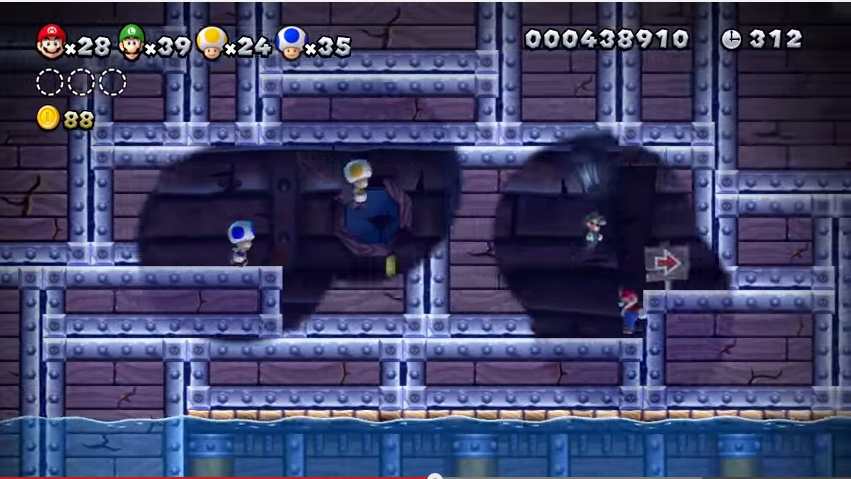
Much like the above mentioned NSMB2, this one is lower on the list for just being a follow-up to a better game. Good levels, and a Luigi-themed expansion pack, coupled with the four player multiplayer makes this a completely competent game, but it hardly utilizes it's hardware, and at best feels like an expansion pack for Mario Wii. There's nothing wrong with NSMBU, but there's nothing that really sets it apart either. 


6 - Mario Land 2 (Gameboy)


Mario Land 2 might be the most unknown game on this list, but that's a shame since it's really good. Completely disregarding the NES Mario games, ML2 wasn't afraid to put the Gameboy through it's paces. Using sprites from the recent SNES Mario title helped the game look better then it was, and as a potable Mario experience, it's amazing for it's time. 

5 - New Super Mario Bros. Wii (Wii)


Four player co-op Mario might be one of the best and worst ideas the series has ever had. The chaos and carnage created with Mario, Luigi, and two Toads on screen at the same time is something that has to be experienced for real. Not content to just let four people play Mario at the same time, NSMB Wii was a well balanced and well made Mario game that's just fun to play, either by yourself or with friends. 


4 - Mario Brothers (NES, SNES)


The original that started it all, created a legend, and made Nintendo a houshold name. Amazingly, the original Mario Bros holds up pretty well, even thirty years on. It's simplistic, crude, and short, but works in every way. People have often said that Nintendo is afraid to innovate, but that might be because they got it so right on the first try. The platforming in Mario is sublime, and it became the standard of all platformers to follow. 

3 - New Super Mario Brothers (DS)


"New" is something of an odd adjective to place in the title of this game, and yet it fits so well. NSMB was exactly what the Mario franchise needed after so many 3D outings, a complete tear down and return to form with a shiny new coat of paint, and that's exactly what this DS title offered. The gameplay was largely the same as the old Mario games, but it's what it added that made it stand out. The art style was an interesting mix of 3D models on a 2D plane that made the game look better then it really was, but it was the level design itself that stood out. Each level is memorable, even if it doesn't have any sort of gimmick, because of how well put together they are, using angles and shapes the old Mario games barely dreamed of. With plenty of secrets, collectibles, and a player VS player mode, this really is one of the all time best Mario games, best DS games, and best platformers ever made. 

2 - Mario Bros 3 (NES, SNES)


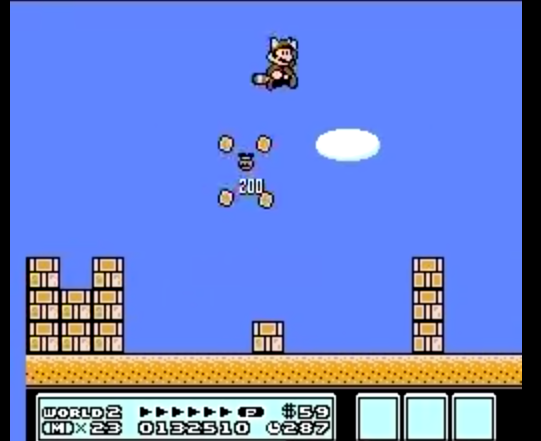
Creating so much of what would eventually become Mario standard, and kicking ass while doing it. Mario 3 was so good that it got it's own HD remake back before that was cool. The level design is a how-to of great design, with each level introducing a new challenge while still keeping in line with the world it exists in. Mario 3 also introduced the idea of non-linear level progression with the over-world map, and added mini-games into the mix as well. Never mind the fact that the game is just really fun to play, with a host of cool power-ups and items, awesomely surreal levels, challenging boss fights, and plenty to see and do. Mario 3 is legendary not only for what it introduced, but also for just being a really amazing game. 

1 - Super Mario World (SNES)


I have lost count of how many times I've beaten SMW. Seriously. It's been out for 25 years and I've beaten it so many times I can't remember any more. 

Super Mario World should be in a museum as a piece of art, and it's damn near perfect from ever angle. The art style is iconic, with expert sprite work that looks great and moves fluidly. The back grounds are colorful and varied, making each level feel different from each other. The platforming is nearly flawless, with jumps that will challenge you and the ability to glide opening up new possibility every few levels. 

It's the levels themselves, I think, that make SMW the masterpiece that it is. There's an obvious pace to the main levels, slowly introducing new ideas as you go and making you figure everything out. Even better is the amount of levels there are to unlock, with entire worlds hidden away behind mysterious keyholes and out of place pipes. 

I really could ramble on forever about what makes Super Mario World so great, but I'm afraid of being accused of having rose tinted glasses. I re-played Mario World again recently, just to see, and while my reflexes aren't what they were when I was seven, the game was still incredibly enjoyable. It's available on the E-shop now, and elsewhere if you know where to look, and I encourage anyone that enjoys Mario games, great design, wonderful artwork, or just a fun game to give it a try. 

Game Over

There it is, my ranking of the Mario 2d platformers. I'd rank the 3d games, but there's not really enough of them, so here it is in short order:

Mario Sunshine
Super Mario Wold Wii U
All of the other ones
Mario 64
Galaxy 2

Personally, to me, Mario is at his absolute best when it's in the 2D realm. Not that I have anything against the 3d games, but platforming just works better in 2D, and it always will. 

The more astute of you may have noticed there are some games missing. The Yoshi's Island series isn't on here since, despite Mario appearing as a baby, the games aren't really about Mario, and even the Nintendo Wiki puts them in a different category. Same goes for any game involving Wario, although he's in a completely different place now. 

All told, this is just my personal opinion on one of the greatest and longest running franchises in gamine. If you have differing opinions that's fine, it just means you're a human. At the end of the day, any Mario game is, to me, a good Mario game.